Darts is one of the simplest sports to bet on and one of the easiest to get wrong. Two players, no draw, a result inside an hour. That simplicity is why punters pile four short-priced favourites onto one slip during the World Championship and then wonder why it keeps coming unstuck.
This guide covers how to bet on darts properly: the markets, the sets-and-legs format, and why a first-round four-fold is a very different bet to a Saturday football acca. Our guide to how accumulator bets work covers the structure in full.
To bet on darts, you pick a market, most often the match winner, choose your selection, set your stake, and confirm the bet. At a tournament like the PDC World Darts Championship, you can combine several match winners from the same session into a darts accumulator, where every leg must win for the slip to pay.
Darts is a two-player sport with no draw in PDC match play, so match winner is a straight two-way market. There is no draw-no-bet equivalent to think about. A player at 1/3 (1.33) is given roughly a 75% chance before margin; their opponent at 9/4 (3.25) around 31%. Those two add up to more than 100%, and that gap is the bookmaker’s overround baked into the price.
What moves darts odds is different to football: no team news, no suspensions, no rotation. Prices shift on practice-room form, three-dart averages and checkout percentages. A player averaging 98 with a 45% checkout rate is a different bet to the same player averaging 89 and missing doubles, even if the name on the board is identical.
A darts accumulator is two or more selections on a single slip, with the odds multiplied together. Every leg must win. One losing leg and the whole bet goes down, no matter how comfortable the other three looked.
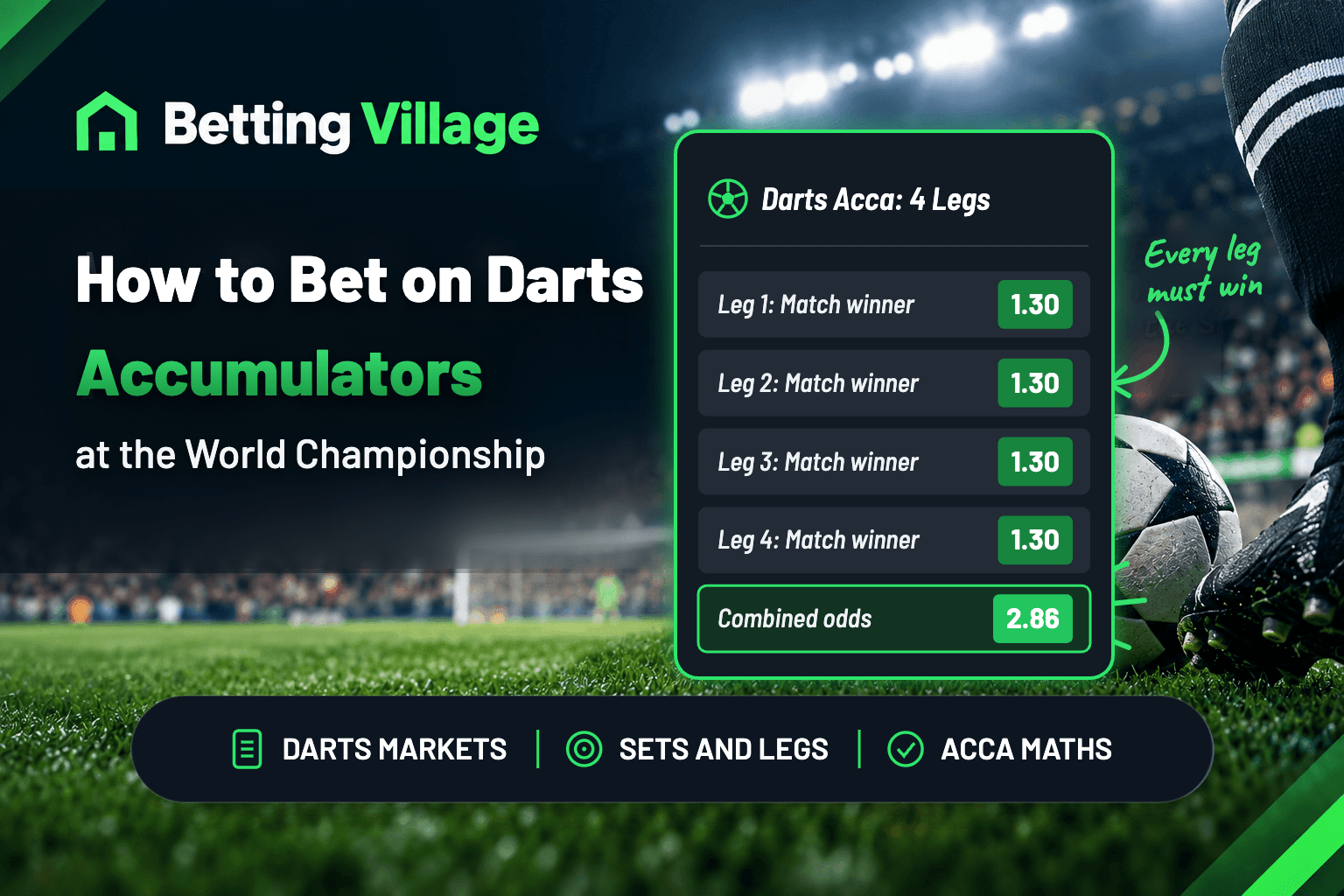
The maths is straightforward. Back four players at 1.30 each and the combined price is 1.30 x 1.30 x 1.30 x 1.30 = 2.86. A £10 stake returns £28.56 including stake, so £18.56 profit. Four short prices still multiply into a bet that is a long way from a formality.
A World Championship session suits an acca because the schedule hands you four or five matches on the same card, all settled within a few hours. If you want fewer moving parts, a treble bet cuts the slip to three legs. If you want a structure that still pays something when one selection loses, a Lucky 15 splits four selections across 15 separate bets, so three winners from four still returns money. It costs more up front, but in a round where upsets are common, that matters.
The process is the same whether you are backing one match winner or building a five-fold:
Quick tip: check whether the handicap or correct score market you are looking at settles on sets or on legs before you confirm. A 3-1 in sets and a 3-1 in legs are different outcomes, and mixing them up is one of the most common beginner mistakes in darts betting. Read your bookmaker’s darts rules on withdrawals before you place the bet, not after a player has pulled out.
The World Darts Championship is played over sets rather than straight legs. A leg is a single game, starting at 501 and finished on a double. A set is won by the first player to win three legs. A match is won by the first player to reach the required number of sets for that round.
Match length grows as the tournament progresses. The early rounds are the shortest, the quarter-finals and semi-finals are longer, and the final is the longest match of the event by a clear margin. The PDC also applies a deciding-set rule, so the final set cannot be taken on a single-leg advantage as earlier sets are, with a tie-break element if the players cannot be separated. Format details have been revised more than once, so check the current rules on the official PDC World Darts Championship tournament page before you build anything around match length.
We have left out years, dates, draw details, and player names on purpose because they change every season. The sets and legs structure, and the principle that matches get longer round by round, is what affects your bet.
A short match is a small sample. In a best-of-five-sets first-round tie, a player can lose the opening two sets while finding their range and run out of road. In a best-of-13-sets final, the same slow start costs a third of one set, and there are hours to correct it. That is why upsets cluster in the early rounds and thin out as match length grows.
Apply that to the acca maths. Four favourites at 1.30 each combine to about 2.86, an implied chance of roughly 35% before the bookmaker’s margin, so the slip loses around 65% of the time. Every leg looks short on its own, and the bet is still nearer a one-in-three shot than anything comfortable.
Work it from the probability side, and you get the same answer. If each player genuinely has a 75% chance of winning, 0.75 to the power of four is 0.316, so about 32%. Factor in short early-round matches and that number drops again.
| Legs in the Acca | Chance Each Leg Wins | Chance the Whole Slip Wins |
|---|---|---|
| 2 | 75% | 56% |
| 3 | 75% | 42% |
| 4 | 75% | 32% |
| 6 | 75% | 18% |
The practical takeaway: keep leg counts lower in the early rounds, and treat a short price in a short match as a price that still must survive a bad 20 minutes on stage.
Here is a fourfold built from match-winner selections. The players are illustrative placeholders, and the prices are examples, not live odds or selections.
| Leg | Market | Fractional Odds | Decimal Odds | Implied Probability |
|---|---|---|---|---|
| Player A v Player B | Match winner: Player A | 1/3 | 1.33 | 75% |
| Player C v Player D | Match winner: Player C | 4/9 | 1.44 | 69% |
| Player E v Player F | Match winner: Player E | 8/13 | 1.62 | 62% |
| Player G v Player H | Match winner: Player G | 4/6 | 1.67 | 60% |
Multiply those four decimals together, and you get 5.18. A £10 stake returns £51.80, including the stake, for a £41.80 profit. The combined implied probability is roughly 19% before margin, so this slip loses about 4 out of 5 times.
If three legs land and the fourth loses, the return is nothing. Some bookmakers offer cash out on darts multiples while matches are in play, which lets you take a reduced figure before the last leg plays out. That figure carries a margin, so you are trading potential return for a settled position.
Match winner is not the only option. A 180 is the maximum score from three darts, three treble 20s in one visit, and the total 180s market asks whether the combined count in a match goes over or under a set line. Those lines scale with match length, so an over 9.5 line in a short first-round match and the same line in a semi-final are not the same bet.
Leg handicaps are useful when a match winner price is too short to back on its own. Instead of taking 1/5 on the favourite, you give them a deficit in legs and take a higher price. Highest checkout markets swing on how often a match reaches a tight final leg, because players only take on big finishes when the situation forces it.
Bet builders let you combine a match winner with a 180s line inside the same match. Those legs are correlated, so they are priced differently from the same two selections when they sit as separate acca legs.
For the full breakdown of every market and how we approach each one, our darts betting tips hub goes into more detail.
Players do withdraw from the World Championship. Illness and injury pull-outs before a scheduled match happen most years, and a player can retire mid-match too.
How that is settled depends on your bookmaker. The common outcomes are: the leg is voided and the rest of the acca stands at reduced odds, the bet is settled if the rules deem a result to have been reached, or the stake is returned. Outright and each way bets on a player who withdraws after the tournament has started are usually treated as losers.
Operators licensed by the Gambling Commission must publish clear terms and apply them consistently, but those rules are not identical across the market. Read the darts section of your own bookmaker’s betting rules rather than assuming.
| Quick tip: Note the rule before a long tournament starts. You do not want to be reading settlement terms at 11 pm after a retirement has just gone through your slip. |
Yes, you can bet each way on the darts outright. An each way bet is two bets in one: half your money on the outright win, half on the player reaching a set place position. A £5 each-way outright bet costs £10 in total.
Back a player at 25/1 each way with 1/2 odds a place and two places paid, and the place part settles at 12.5/1 if they reach the final. On a £5 each-way stake, that returns £67.50 from the place half alone, plus the win part if they go all the way. Place terms vary by event and field size; semi-final and final terms are both common on darts outrights, so check before you stake. Our guide to each-way betting covers the full mechanics.
An outright is a multi-week bet. Your money is tied up from the first session to the final, which is worth factoring into your staking across the tournament.
The World Championship runs for weeks with play on most days, often afternoon and evening sessions. That is a different bankroll problem to a one-off Saturday acca. A £10 slip per session adds up quickly across 20-plus betting days.
Decide your total tournament budget before the first dart is thrown, divide it by the number of days you expect to bet, and set deposit limits in your account rather than relying on willpower in December. A run of short-priced accas going down is normal variance given the maths above, not a reason to increase your stakes.
Betting should be fun. 18+ only. Free, confidential support is available from BeGambleAware and GamCare, or via the National Gambling Helpline at 0808 8020 133.
Betting Village is not a bookmaker, and all tips reflect our own opinions, so do your own research before placing any bet.
You now have the mechanics of how to bet on darts: the markets, the sets-and-legs format, the acca maths, and what happens when a player pulls out.
For the selections themselves, our darts coverage runs through every major PDC event, with stats for each pick, from three-dart averages to checkout percentages. See our free darts betting tips for every major PDC event.
18+, begambleaware.org. Betting Village is not a bookmaker, and all tips reflect our own opinions.
It depends on the round. Early-round matches are the shortest, and the required number of sets increases as the tournament progresses, with the final the longest match of the event. The PDC publishes the current round-by-round format on its official tournament page, which is worth checking each season.
Yes. Every selection in a darts acca must win for the bet to pay out. One losing leg and the whole slip is settled as a loser, unless that leg is voided under your bookmaker’s rules, in which case the acca usually stands at reduced odds.
A deciding set is the final set of a match when both players are level on sets. The PDC applies a specific rule requiring a winning margin rather than a single-leg advantage, with a tie-break element if neither player pulls clear. Check pdc.tv for the current wording.
Often, but not always. Availability depends on your bookmaker, the markets involved, and whether matches are in play. The figure offered always includes a margin so that it will be less than the full potential return. Our cash out guide explains when taking the offer makes sense.