BTTS means both teams to score. The market will often have a Yes and a No next to it. This guide gives you the full answer: how the bet settles, what the odds are telling you, and the stats worth checking first. It is also one of the first markets punters reach for when putting together a bet builder.
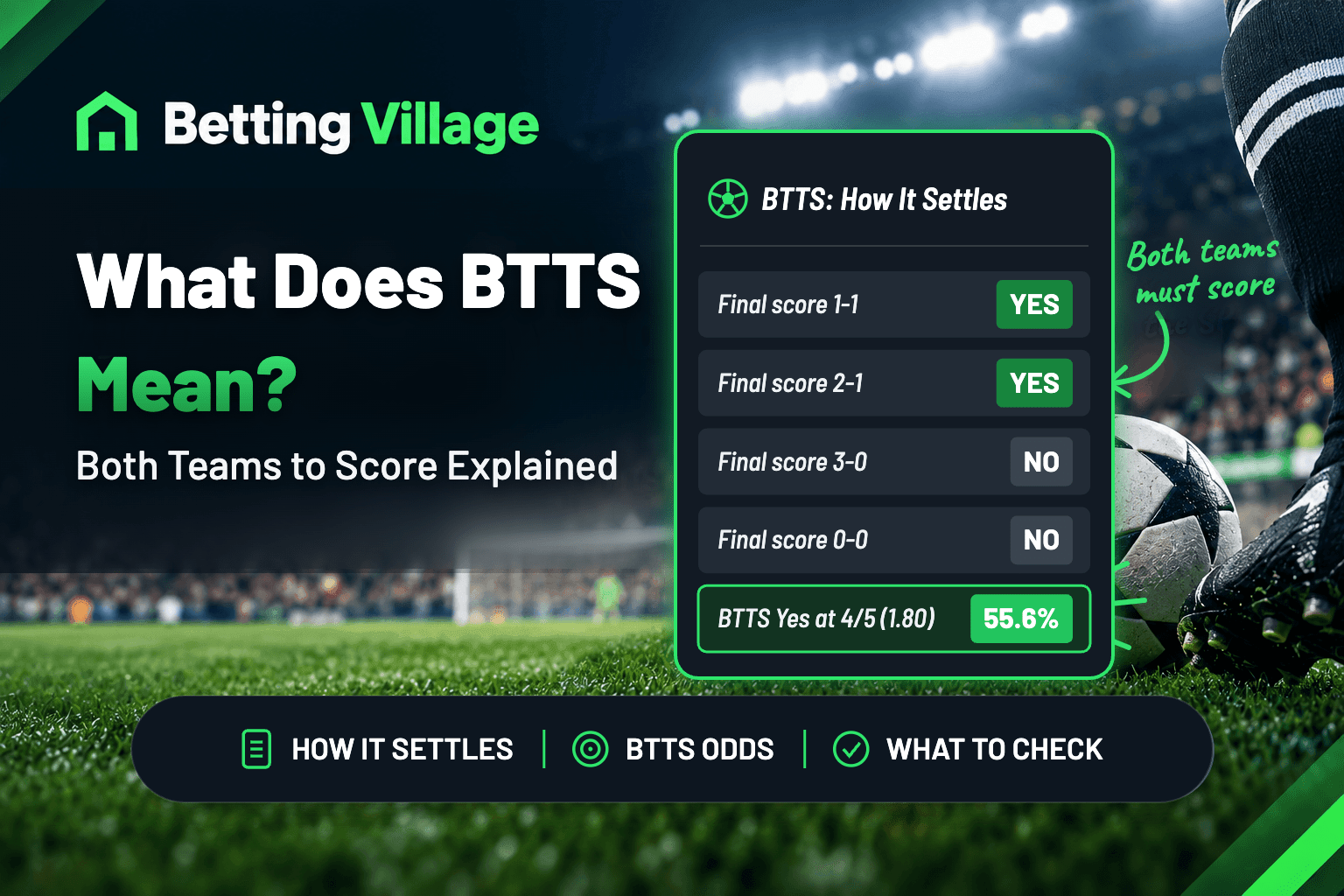
BTTS stands for both teams to score. BTTS Yes wins if each team scores at least one goal in the match. BTTS No wins if one or both teams fail to score. The final score is the only thing that matters, not who scored first and not who won the game.
That last point catches people out. A 1-1 draw and a 3-2 home win settle BTTS Yes in the same way, because the result is irrelevant to this market. You are betting on one question: did both sides get on the scoresheet?
Some sites and apps label it GG and NG. GG means goal-goal, which is BTTS Yes. NG means no goal, which is BTTS No. Your bookmaker might also list it as “Both Teams to Score?” or “Goals – Both Teams to Score”, or tuck it inside a goals tab rather than the main coupon: different naming, identical market.
A BTTS bet is settled on the official full-time score, so a 94th-minute consolation counts the same as a goal in the opening minute. Here is how the common scorelines settle.
| Final Score | BTTS Yes | BTTS No | What Happened |
|---|---|---|---|
| 1-1 | Wins | Loses | Both sides scored, so the draw is irrelevant |
| 2-1 | Wins | Loses | Home win with both teams on the scoresheet |
| 3-0 | Loses | Wins | Plenty of goals, but only one team scored |
| 0-0 | Loses | Wins | Neither team scored, so BTTS No lands |
| 1-0 | Loses | Wins | A goal went in, but the away side blanked |
| 1-1 (away goal is an own goal) | Wins | Loses | Own goals are credited in the official score, so BTTS Yes still lands |
The 3-0 row is the one new punters trip over. Three goals feel like a goal-heavy game, but BTTS asks about both teams, not total goals. If you would rather bet the exact result, our guide to correct score betting covers how those prices are built.
| Quick tip: Before you confirm the slip, say the expected scoreline out loud. If you are picturing a comfortable 2-0 for the favourite, BTTS Yes is not the bet you want. |
BTTS Yes usually prices shorter in high-scoring, open leagues. BTTS No shortens when a side with a strong clean sheet record meets a team struggling badly for goals. Neither side is the safer option by default. They are two halves of the same question at different prices, and both lose regularly.
A Bundesliga fixture between two attacking sides who press high and concede chances might see BTTS Yes priced around 1.55. A Championship game where both teams average under a goal per match, and the away side has scored twice in seven on the road, could push BTTS Yes out to 2.20 or longer, with No the favoured side.
You will also see both teams to score and no draw, sometimes listed as “both score, no draw”. That requires both sides to score, and for the game to produce a winner, so 1-1 fails where 2-1 succeeds. If you want a softer version of the result question rather than a stricter one, double chance works differently again.
Standard BTTS settlement covers 90 minutes plus stoppage time. Extra time and penalty shootouts do not count unless the market is explicitly labelled as including them. If a League Cup tie is 1-0 after 90 minutes and the losing side equalises in the 105th minute, your BTTS Yes bet has already lost.
Own goals count. They are credited to the team shown in the official score, so a 1-1 where the away goal came off a defender’s shin still settles BTTS Yes.
Abandoned and postponed matches follow each bookmaker’s own rules. Some void all bets on an abandoned game and return your stake; others settle if the fixture is completed within a stated window. There is no single universal rule, so open the market rules in your own app before you stake.
The Gambling Commission requires licensed operators to publish clear terms, and those terms are the ones your bet is settled under. In cup competitions, watch for a separate “both teams to score including extra time” market, which is priced longer than the 90-minute version.
Every BTTS price converts into a percentage chance. Take 4/5, which is 1.80 in decimal form. Divide 1 by 1.80, and you get 0.556, so that price implies roughly a 55.6% chance of both teams scoring, before the bookmaker’s margin is stripped out.
| Decimal Odds | Fractional | Implied Probability | What the Market Is Saying |
|---|---|---|---|
| 1.50 | 1/2 | 66.7% | Both teams expected to score in around 2 of every 3 meetings |
| 1.80 | 4/5 | 55.6% | Slightly odds-on, a fairly open game |
| 2.00 | EVS | 50% | Priced as a coin flip before margin |
| 2.50 | 6/4 | 40% | The market leans towards a clean sheet somewhere |
Now the margin. If BTTS Yes is 1.80 (55.6%) and BTTS No is 1.90 (52.6%), the two combined total 108.2%. That extra 8.2% is the overround, the bookmaker’s built-in edge, which means the true probabilities are slightly lower than the raw numbers suggest.
So which odds are good for BTTS? It depends on your own estimate. If both teams score in about 6 of 10 meetings of this type (60%), a price implying 55.6% is worth a look. If your estimate is 50%, the same price is poor value no matter how much you fancy the game. In high-scoring fixtures, BTTS Yes often sits around 1.50-1.60; in tight defensive matchups, it stretches past 2.20.
Combination markets stack a second condition onto the same match. Both parts have to land, which is why the prices are longer.
The trade-off is simple. Bigger price, narrower set of scorelines that pay. A 2-0 win is a perfectly good result and a losing BTTS and win bet.
Knowing what BTTS means is the easy part. Judging whether the price is fair takes a bit of homework. Run these checks before you back either side.
League context is a starting point, not a conclusion. Bundesliga and Eredivisie fixtures have historically produced more BTTS Yes results than tight Serie A matchups, but a league average tells you nothing about two specific teams on a wet Tuesday night. Check confirmed line-ups around 30 minutes before kick-off as well, because that is often when the price moves and when you find out whether the striker whose record you just studied is starting. For fixtures we have already run the numbers on, head to our BTTS tips.
Here is what stacking BTTS legs does to your chances. Four BTTS Yes legs each at 1.80 imply 55.6% individually. Multiply those together (0.556 x 0.556 x 0.556 x 0.556), and you get roughly 9.5%, which is why the acca pays around 10.50.
Put plainly, a single at 1.80 lands a bit more often than not. The same selection four times over lands less than one time in ten. One 0-0 anywhere on the slip kills the lot, and goalless draws happen in every league every weekend.
Cash out and bet builders give you other ways to use the same market, either taking a return before the final whistle or combining BTTS with corners, cards, or a result on a single match. For staking, returns, and bet types in full, see our guide to how accumulator bets work.
Whatever you build, stake an amount you are comfortable losing. Betting should be fun. 18+ only, and both BeGambleAware and GamCare offer free support if you want help setting limits.
Now that you know what BTTS means, how it settles the full-time score, and how to read the price against your own numbers, the next step is picking fixtures.
See today’s free both teams to score tips for the games we have flagged, with the scoring and clean sheet numbers behind each one. We post by 9 pm the night before, where possible.
We are not a bookmaker, and all tips reflect our opinion, so always do your own research before placing a bet. 18+, begambleaware.org.
GG stands for goal-goal and is the same as BTTS Yes, meaning both teams score. NG stands for no goal and matches BTTS No, meaning at least one team fails to score. Some apps and stats sites use GG/NG labelling instead of BTTS, but the market and settlement are identical.
It depends on your bookmaker’s rules. Many void bets on abandoned matches and return your stake, while others settle if the fixture is completed within a set window. There is no single industry-wide rule, so check the market terms in your own account before staking.
You pick a group of teams, and the bet pays if any 3 of them win their match with both teams scoring in each of those games. Every qualifying game requires two conditions to be met, so a 2-0 win does not count. That difficulty is why the price is much longer than a treble.
BTTS and win combines a match result with both teams scoring. You name a team to win, and both sides must find the net, so 2-1 and 3-2 land while 1-0 and 2-0 do not. It pays better than a straight win bet because two conditions must come in.
A good price is one longer than your own estimate of the chance. At 1.80, the market implies 55.6%. If your research says both teams score in around 6 of 10 similar fixtures (60%), that price has value. If you make it 50%, it does not, regardless of the teams involved.
The letters get used loosely in other contexts online, but in football betting BTTS means both teams to score, and that is the meaning that applies on any bet slip or odds page you come across.