If you have ever loaded 6 horses onto a slip, clicked Lucky 63, and watched the total stake jump to £63, the structure is doing a lot of work behind the scenes. We get asked about this bet more than almost any other full cover option, usually by punters who have already tried a Lucky 15 bet and want to add 2 more selections.
Here is the Lucky 63 bet explained in full, with the maths written out so you can check every figure yourself. 18+ only.
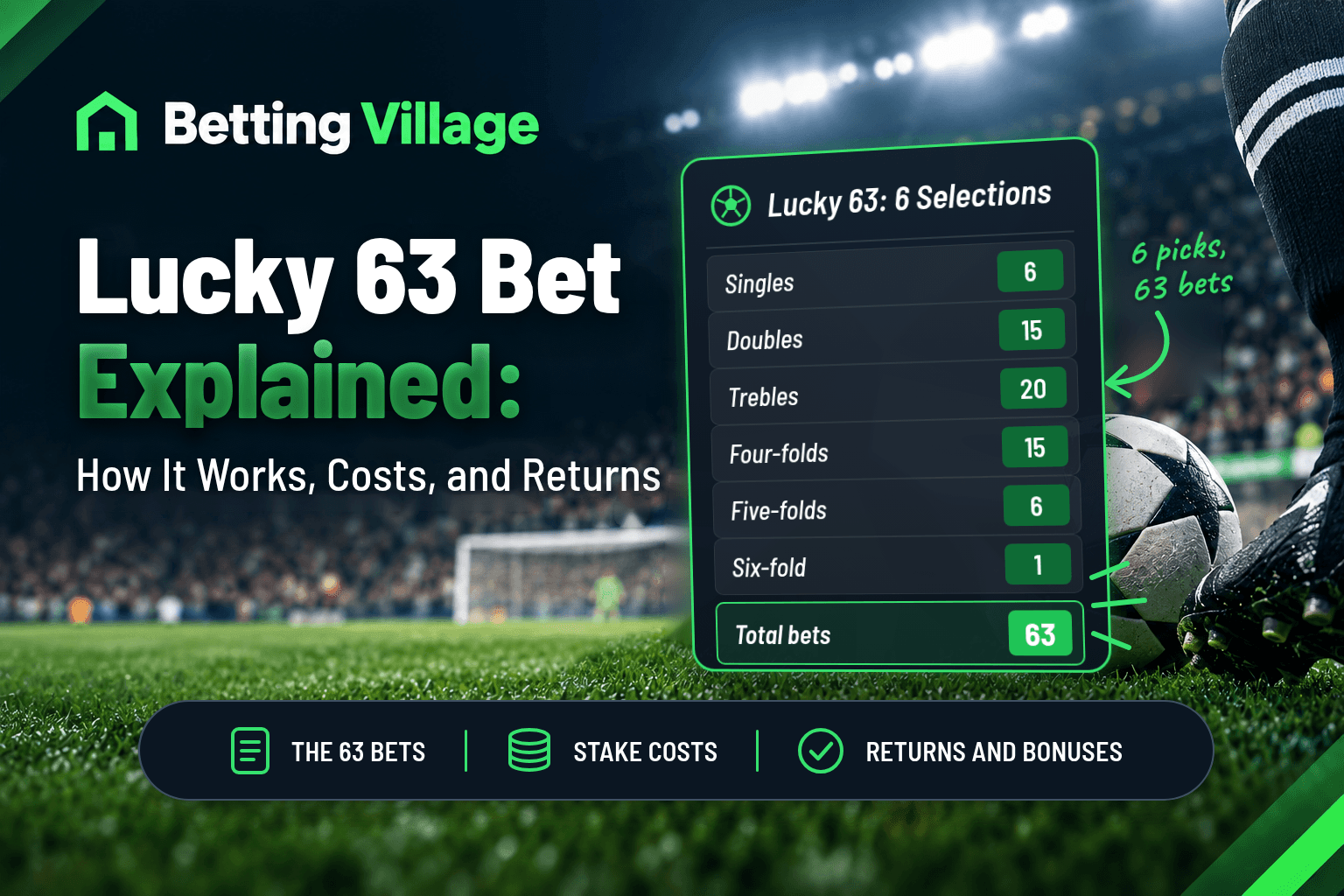
A Lucky 63 is a full cover bet on 6 selections made up of 63 separate bets: 6 singles, 15 doubles, 20 trebles, 15 four-folds, 6 five-folds, and 1 six-fold accumulator. Every one of those 63 bets is settled individually, so a single winner still returns money even when the other 5 lose.
The singles are the defining feature. A Heinz covers the same 6 selections across 57 bets but leaves the singles out, so 1 winner pays nothing at all. The Lucky 63 puts them back in, and they are the reason bonuses exist on Lucky bets at all.
Your 6 selections have to be in different events: 6 horses in 6 different races, with the slip refusing 2 runners from the same race. It is most common at the big festivals, but nothing stops you from building one across 6 football matches using match result, both teams to score, or over/under goals markets.
| Bet type | Number of bets | Winners needed for that bet to land |
|---|---|---|
| Singles | 6 | 1 |
| Doubles | 15 | 2 |
| Trebles | 20 | 3 |
| Four-folds | 15 | 4 |
| Five-folds | 6 | 5 |
| Six-fold accumulator | 1 | 6 |
| Total | 63 |
The numbers come from straightforward combination maths. 6 selections taken 2 at a time give 15 doubles, taken 3 at a time give 20 treble lines, and so on. Every possible combination of 6 items comes to 63, which is 2 to the power of 6 minus 1. Each selection appears in 32 of the 63 bets, a figure worth remembering when we get to Rule 4.
| Quick tip: The Lucky family scales with the number of selections. Lucky 15 is 4 selections across 15 bets, Lucky 31 is 5 selections across 31 bets, and Lucky 63 is 6 selections across 63 bets. All 3 include the singles. |
Your total stake is the unit stake multiplied by 63 for win only, or by 126 for each way. There is no rounding and no cap; the slip simply multiplies.
| Unit stake | Win only (63 bets) | Each way (126 bets) |
|---|---|---|
| 10p | £6.30 | £12.60 |
| 20p | £12.60 | £25.20 |
| 50p | £31.50 | £63.00 |
| £1 | £63.00 | £126.00 |
| £2 | £126.00 | £252.00 |
A 50p each-way Lucky 63, therefore, costs £63, which is where the outlay starts to bite. Move to a £1 unit each way, and you have committed £126 before the first race is off. With any full cover bet, you pay for all 63 lines, whether they end up relevant to the result or not.
Returns on a Lucky 63 are the sum of every winning line. We will use 6 horses priced at 2/1, 3/1, 5/2, 4/1, 6/4, and 9/2 at a £1 unit stake, a win-only outlay of £63. Returns below include the stake, and the table adds the winners in that stated order.
| Winners | Prices landing | Total returns | Profit or loss on £63 |
|---|---|---|---|
| 1 | 2/1 | £3.00 | -£60.00 |
| 2 | 2/1, 3/1 | £19.00 | -£44.00 |
| 3 | 2/1, 3/1, 5/2 | £89.00 | +£26.00 |
| 4 | 2/1, 3/1, 5/2, 4/1 | £539.00 | +£476.00 |
| 5 | 2/1, 3/1, 5/2, 4/1, 6/4 | £1,889.00 | +£1,826.00 |
| 6 | All 6 | £12,284.00 | +£12,221.00 |
Check the 2-winner line by hand. The 2/1 single returns £3, the 3/1 single returns £4, and the double on the pair is priced at 11/1, returning £12. That is £19 from 3 winning lines out of 63. At 3 winners, you add a third single of £3.50, 2 more doubles worth £10.50 and £14, and the treble at 41/1 returning £42, which takes the total to £89.
So how many winners do you need on a Lucky 63? There is no fixed number, because the prices decide it rather than the count. In this example the 3 shortest prices (6/4, 2/1, and 5/2) return £62.00, a £1 loss, while 2/1, 3/1, and 5/2 return £89.00 and the 3 longest (9/2, 4/1, and 3/1) return £194.00. Longer-priced winners drag the break-even point down because they inflate every double, treble, and four-fold they sit in. These figures are arithmetic on a fixed set of prices, not a prediction of what any bet will return.
Bonuses are paid by the bookmaker rather than built into the bet type, and there are 2 common forms. The first is a consolation when only 1 of your 6 selections wins: some firms double, or otherwise enhance, the odds on that winning single. The second is an all-winners bonus, where a percentage is added to total returns if all 6 selections win.
Amounts, qualifying conditions, and whether a bonus applies to the each-way portion vary between operators. Bonuses are normally calculated on returns rather than stake. They are often excluded when a Rule 4 deduction applies, when a selection is a non-runner, or in certain meetings and markets.
An each-way Lucky 63 splits every one of the 63 bets into a win part and a place part, taking the total to 126 bets. A 20p each way Lucky 63, therefore, costs £25.20.
Place terms are set race by race, commonly 1/5 or 1/4 of the win odds for a stated number of places, depending on field size and race type. A selection that only places still feeds the place side of every double, treble, four-fold, five-fold, and the accumulator it appears in, so a day of near misses can still return something.
Our guide to each-way betting covers how place terms are calculated.
This is where the stake escalates fastest, so if you want the place cover, halve the unit stake rather than double the budget.
| Bet | Selections | Bets | Singles included | Stake at £1 unit | Bonuses |
|---|---|---|---|---|---|
| Lucky 63 | 6 | 63 | Yes | £63 | Commonly offered |
| Heinz | 6 | 57 | No | £57 | Not normally offered |
| Lucky 31 | 5 | 31 | Yes | £31 | Commonly offered |
| Lucky 15 | 4 | 15 | Yes | £15 | Commonly offered |
The Lucky 63 and the Heinz cover the same 6 selections. The Heinz is 6 units cheaper per unit stake because it strips out the singles, but that also means 1 winner returns nothing, and you forfeit any bonus. The Lucky 31 and Lucky 15 are the same structure with 5 and 4 selections, and both are kinder on the total outlay. The next step up is the Goliath: 8 selections across 247 bets, totalling £247 at a £1 unit.
Pros:
Cons:
A Lucky 63 is a staking structure, not a method of picking winners. It changes how your money is spread across outcomes, nothing more.
Now you know what a Lucky 63 costs and what it needs to return, the next step is the selections. We publish our racing picks with the form, course record, and trainer stats behind each one, so you can see the reasoning before anything goes near your slip. Have a look at our free Goodwood tips, and if you want us to run through a staking question, message us on X.
bettingvillage.net is not a bookmaker, and all tips reflect our personal opinions, so do your own research before betting. Betting should be fun. Gamble responsibly. 18+ only. begambleaware.org.
You need 6 selections, each in a different event. That means 6 horses in 6 separate races, or 6 different football matches. You cannot include 2 runners from the same race because each selection must be capable of winning independently.
It depends on the odds rather than a set number. In our £1 worked example, 2 winners always resulted in a loss, while 3 winners returned between £62.00 and £194.00 on a £63 stake, depending on which prices landed.
Yes. Most UK bookmakers accept a Lucky 63 across 6 football matches, using markets such as match result, both teams to score, over/under goals, and double chance. The 6 selections must come from 6 different fixtures, and related contingency rules apply as normal.
No. A six-fold accumulator is 1 bet needing all 6 selections to win. A Lucky 63 contains six-fold plus 62 other bets, including the 6 singles, so partial success still returns money. It also costs 63 times more at the same unit stake.
Where a bookmaker offers BOG on a race, it applies per selection. If your horse starts at a higher price than you took, that SP is used in every bet containing it, all 32 of them. Terms differ by operator, and BOG is usually limited to UK and Irish racing.
The single on that selection is refunded, and every other bet containing it loses a leg. In practice, the remaining 5 settle as a Lucky 31 at double your unit stake. Bonus eligibility is commonly lost, and settlement rules vary, so check with your bookmaker.
Your total stake of 63 units wins only 126 units each way. At a £1 unit, that is £63 or £126, and at a 50p unit, it is £31.50 or £63. You cannot lose more than the amount placed on the slip.