Watching a cash-out figure climb on a four-fold and wondering whether to tap it or let it run is one of the most common moments in modern betting, and also one of the easiest to get wrong. Cash out has become a standard feature across nearly every bookmaker. Yet, most bettors use it on instinct rather than understanding how the figure is calculated or what it quietly costs them compared with promotions such as acca insurance.
This guide breaks down what cash out really is, how bookmakers calculate it, and when taking it (or leaving it) actually makes sense from a stats-led perspective.
Cash out lets you settle a bet before the event has finished for a value offered by the bookmaker, which can be more or less than your original stake. Accept it, and the bet is closed at that figure, whatever happens afterwards.
It is not a withdrawal of your own money, nor a refund. The bookmaker is buying your open bet back at a price based on how your selections are currently performing. Cash out runs in-play on most mainstream football markets and pre-match on some, depending on the operator, and it is a commercial feature rather than a consumer right. Terms differ between bookmakers, which is why the Gambling Commission requires licensed operators to set those terms out clearly rather than impose a single standard rule across the market.
Your open bet appears in the My Bets area of the app, with a cash-out figure next to it. That figure moves in real time with the live odds on your remaining selections: it rises when they are ahead and falls when they are behind. Tap to accept, and the value is credited to your main balance within seconds.
A £10 single on a Premier League side at 2/1 carries a £30 potential return. Go 1-0 up on the hour, and the cash out offer might sit around £22, because the market now rates your side as heavy favourites. Fall behind, and that same offer could drop under £3. If the price shifts between you tapping and the bookmaker confirming, the request fails, and you are usually shown a re-quoted figure to accept or decline.
| Quick tip: Check whether cash out is available on your bet before you place it, not after. Some markets never carry it, and finding out mid-match is a frustrating way to learn. |
3 versions exist, and availability varies by bookmaker.
3 inputs drive the figure: your stake, the odds you originally took, and the current live odds on your remaining selections. In plain English, the offer reflects what it would cost the bookmaker to lay your bet off at today’s prices, minus their margin.
That margin is why the offer almost always sits below the bet’s true mathematical value. Live prices already carry an overround, and on an accumulator that margin compounds across every remaining leg, so the longer the acca, the wider the gap between the offer and fair value tends to be.
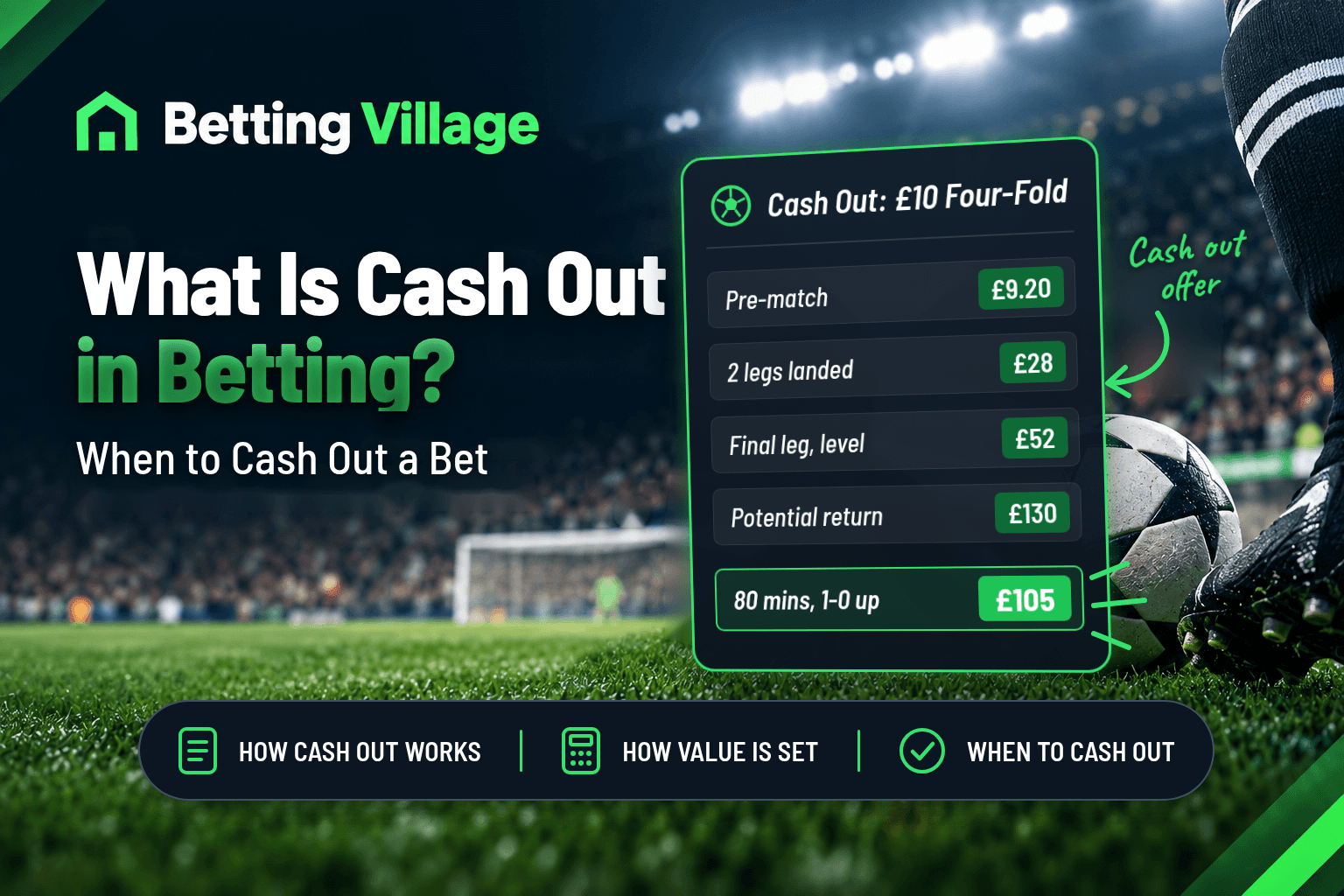
The worked example below is illustrative only. It tracks a £10 4-fold struck at 12/1, a £130 potential return, through 4 points of the bet. Figures are rounded, and real offers vary by bookmaker and market.
Notice the pre-match row. Cash out immediately after placing a bet, and you lose money straight away, because you pay the margin twice: once on the original price and once on the buy-back.
Markets suspend at the precise moments punters most want out. Goals, penalties, red cards, and VAR checks all freeze in-play pricing, so the button greys out until the referee restarts play and the feed updates. Other common blockers:
Bookmakers also reserve the right to void a cash-out settled at an obviously incorrect price. That clause sits in standard operator terms and is worth knowing before you assume a surprisingly generous figure is yours to keep.
These are the terms that catch people out, and they genuinely differ between operators.
We will not pretend one rule covers every bookmaker. Read the cash-out section of your operator’s terms, particularly if a promotion is attached to the bet.
Cash out works best in response to new information, not to nerves. Reasons that stand out include a red card for one of your selections, a key injury confirmed in the warm-up, late team news indicating a heavily rotated side, or a change in weather that undermines an over 2.5 goals leg. In each case, something has changed that you could not have priced when you placed the bet.
Protecting an outsized return is also defensible. If a £10 acca is showing £105 with 1 leg left and that leg is close to a coin flip, taking a figure near fair value is a reasonable call. Partial cash out suits the middle ground: bank an amount you are comfortable with and leave the rest running.
Reasons that do not stand up: cashing out at 1-0 up in the 20th minute because you cannot watch any more, accepting an offer well below fair value, or tapping simply because the number looks large.
A quick sanity test. Convert the live price on your remaining selections into a rough return, then compare it to the offer. If a 1/6 shot would pay £130 and you are being offered £75, you are paying heavily for certainty. If the offer is within a few % of that figure, the margin is reasonable.
Our honest view after years of posting daily accas: the discipline that decides results is selection quality before kick-off, not panic management after it. Cash out is also not a tool for chasing losses. If you find yourself cashing out and immediately restaking, stop.
Support is available at begambleaware.org and through the National Gambling Helpline, run by GamCare, on freephone 0808 8020 133. 18+.
Hedging means placing a second bet to lock in a position while the original stays open, typically a lay bet on an exchange or an opposing bet elsewhere. Cash out does the same job in a single tap within a single account, at the price set by the bookmaker.
Hedging gives you control of the price and often a better net position, but it takes more work, exposes you to exchange commissions, and carries the risk of the market moving while you get the second bet on. For most recreational bettors, cash out is the practical route. Hedging suits those already comfortable reading exchange prices in real time.
Everything above covers what cash out in betting is and how the offer is priced, but the best cash out decision is still the one you never need to make. That starts with what goes on the slip, which is why we publish our free football accumulator tips with the stats behind every leg, posted by 9 pm the night before, where possible. Got a cash out question on an open acca? Message us on X, and we will give you our honest read. Betting Village is not a bookmaker, and all tips reflect our personal opinions, so do your own research before placing any bet.
Betting should be fun. Gamble responsibly. 18+ only. begambleaware.org.
Yes, most bookmakers offer cash out on football accumulators once at least 1 leg is in play. The exception is when a single selection is ineligible, such as certain bet builder legs or outright markets, which can disable cash out on the whole acca.
With most operators, yes. You can take several partial cash-outs as the match develops, each one reducing the remaining stake. Some bookmakers enforce a minimum remaining stake, so you may be blocked once the residual bet becomes too small.
Because the offer is priced off current live odds, which include the bookmaker’s margin, and because your selections have not won yet. You are swapping an uncertain larger return for a certain smaller one, and the bookmaker charges for taking on that uncertainty.
The bet stays open and unsettled. Failed requests usually happen because the price moved or the market suspended mid-request. Many bookmakers then display a re-offer at the new figure, which you can accept or decline. Nothing is deducted from your balance.
In-play cash out is standard on major football markets. Pre-match cash-out is offered by some bookmakers but not all, and it almost always returns less than your stake because the margin is applied twice in quick succession.
Often, yes, but the free bet stake is not returned with most operators, so the cash-out value only appears once the bet’s value exceeds the free bet amount. Until then, the figure can show £0.00. Check your bookmaker’s free bet terms.
No. A cashed-out bet is settled and cannot be reinstated, even if your selections go on to win in full. Auto cash-out triggers are final once they fire, so the trigger figure deserves careful consideration.
Usually, yes. Most acca insurance promotions require the bet to be settled naturally, so a full or partial cash-out typically forfeits the refund. Rules vary between bookmakers, so read the specific promotion terms before you tap.