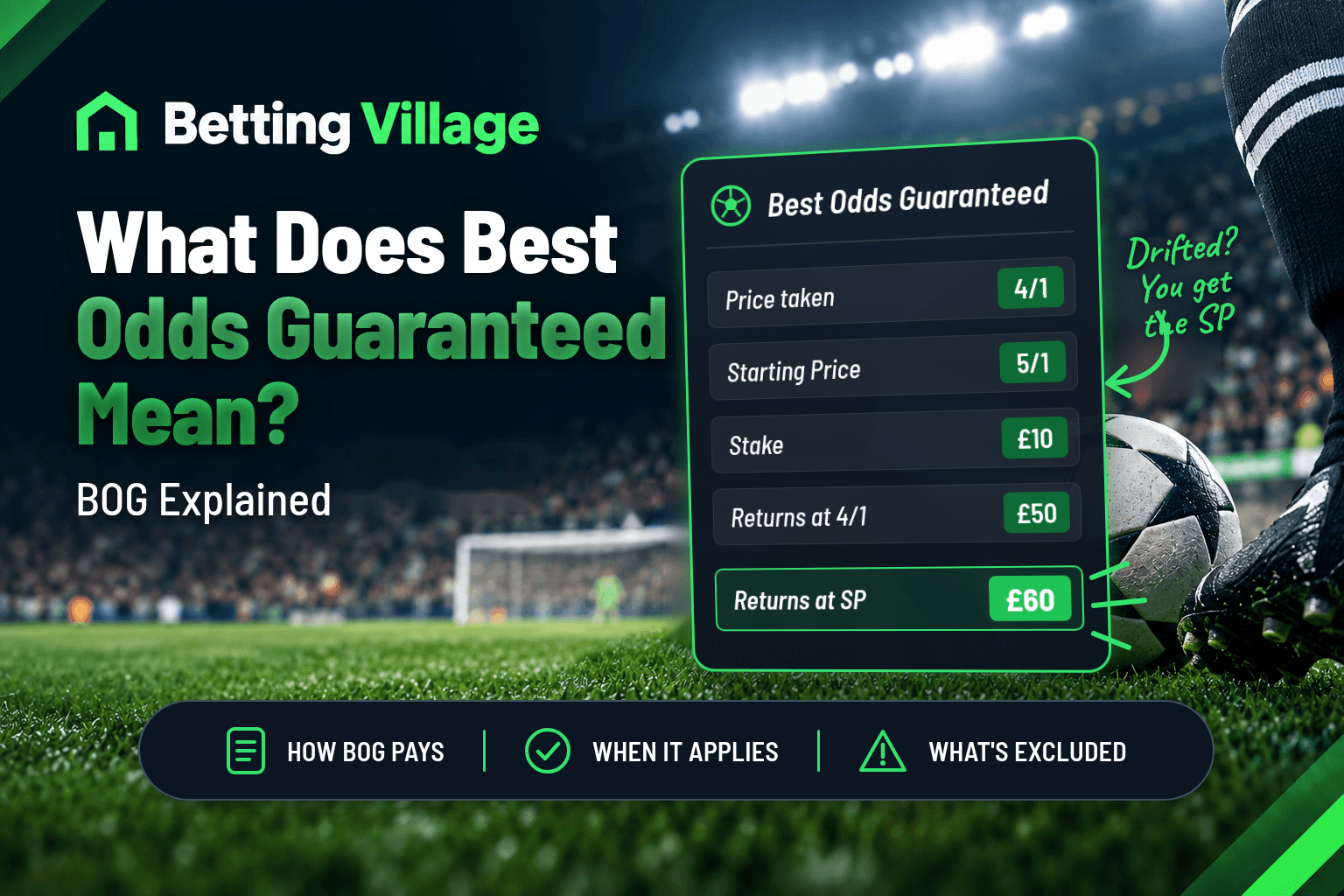
You back a horse at 4/1 in the morning, it drifts to 5/1 by the off, and your bookmaker pays you at 5/1 anyway. That is what best odds guaranteed means in one sentence. If you have seen the BOG badge next to a race on a racecard or in one of our tips posts, this guide sets out what it pays, when it applies, and what it quietly excludes, with real numbers, including how it sits alongside each-way betting. 18+ only.
Best odds guaranteed means that if you take a price on a horse and the official Starting Price returned at the off is bigger than the price you took, the bookmaker settles your bet at the higher price. If the Starting Price is shorter, you keep the price you took. You are paid at the better of the two.
Here is the part most explainers get wrong. BOG compares the price you took with the Starting Price at the same bookmaker. It has nothing to do with matching another bookmaker’s odds. If you take 3/1 with one firm and a rival is showing 7/2, BOG will not top you up to 7/2. Your take price against the SP is the only comparison that matters to us.
The Starting Price is the price returned on a horse at the moment the race starts, formed from the betting market at the racecourse and reported through the industry SP process. BOG itself is a voluntary promotion run by licensed bookmakers rather than a regulatory entitlement, so terms differ between operators and they change.
The arithmetic is simple. Your stake does not change; only the price used at settlement does. These 4 examples cover the situations you will actually meet on a Saturday card.
| Bet | Price Taken | Starting Price | Price Paid | Stake | Returns |
|---|---|---|---|---|---|
| Win single, horse wins | 4/1 | 5/1 | 5/1 | £10 | £60 |
| Win single, horse wins | 4/1 | 3/1 | 4/1 | £10 | £50 |
| Each way, 2nd place, 1/5 odds | 8/1 | 10/1 | 10/1 | £10 e/w (£20 total) | £30 |
| Win single, horse wins | 2/1 | 2/1 | 2/1 | £10 | £30 |
The first row is a drift, so the uplift is worth £10: £50 at 4/1 against £60 at 5/1. The second row is a shortening price, so the SP is ignored, and you are settled at the 4/1 you took. BOG protects you from a drift; it does not reward you for a steamer.
The each-way row is where settlements get queried. A £10 each-way bet is £20 in total, £10 win and £10 place. The horse finishes 2nd, so only the place part pays. At 1/5 odds, the taken price of 8/1 gives a place return of 8/5, or £26. Settled at the SP of 10/1, the place part runs at 2/1 and returns £30, an uplift of £4.
| Quick tip: The uplift is calculated on your stake and the size of the price move, not on how big the odds are. A 4/1 shot drifting to 11/2 is worth more to a £10 stake than a 33/1 shot drifting to 35/1. |
BOG is the standard abbreviation for best odds guaranteed. On a racecard, it appears as a small badge next to qualifying meetings, and tipsters use it as shorthand for a price worth taking early.
It exists in racing and almost nowhere else for one reason: racing is the only mainstream UK betting market with an official Starting Price to measure an early price against. Football has no equivalent, so there is nothing to compare your ticket price to.
Three prices get confused here. An early price is offered in the morning before the market matures. A board price is available in the live on-course market in the minutes before the off. The SP is the single price returned as the race starts. There is no smartest bet in horse racing, but taking a price under BOG terms does mean a drifting price cannot cost you.
Best odds guaranteed generally applies to bets placed from the morning of the race, commonly from around 8 am or from the moment the day’s early prices go up, through to the off. Bets struck the previous evening usually fall outside it, although some bookmakers extend cover to the night before for selected feature races.
The markets covered are normally win and each-way singles on UK and Irish racing, plus the win and each-way legs within qualifying multiples. The race has to be flagged as a BOG race on the card, and not every meeting qualifies. Festival cards, such as Cheltenham in March and Aintree in April, often offer extended terms.
We post our racing tips by 9 pm the night before, where we can, so you can read the reasoning and then decide in the morning whether to take the early price or leave it.
BOG covers less than most punters assume. The following are typically excluded:
Exclusions vary by operator, and the promotion terms on your account are the final authority on what counts.
A Rule 4 deduction applies when a horse is withdrawn after the market has formed. Winnings on bets already struck are reduced on a sliding scale based on the withdrawn horse’s price, because the remaining runners are now better value than the odds you took. The deduction scale is published by the Tattersalls Committee, which adjudicates betting disputes on British horse racing.
Here is the sum. You back a horse at 5/1 with £10, and it wins, but a 25p in the £ Rule 4 applies. Your £50 of winnings is cut by 25% to £37.50, so with the stake back, the bet returns £47.50 rather than £60.
Under most bookmakers’ rules, the BOG uplift is calculated first, and the deduction is then applied to the uplifted price. Take 5/1, see an SP of 6/1 and a 10p in the £ deduction, and you are settled at 6/1 with 10% off your winnings rather than at 5/1. Some operators instead revert affected bets to SP when a late non-runner materially changes the market, thereby removing the BOG benefit entirely.
On an each-way bet, the uplift applies to both parts. The win part is settled at the higher price, and the place part is paid at the agreed fraction of that higher price, which is how the 8/1 into 10/1 example above turns an 8/5 place return into 2/1.
In multiples, BOG is normally applied leg by leg. Each qualifying selection is settled at the greater of your taken price and the SP, and only then is the bet calculated, which is why it compounds in a Lucky 15, a Yankee, or a racing acca. Take 2/1, 3/1, and 5/2 on a £10 win treble, and all 3 landing returns £420. If the first leg drifts and returns an SP of 3/1, the same treble pays £560, an extra £140 from one price move.
A non-qualifying leg, such as a greyhound race or a meeting outside the BOG list, usually does not void the promotion on the other legs. However, a small number of operators treat it differently. Check the multiples clause in your terms.
Take the price when you like it, and let the best-odds guarantee cover the drift. A price that lengthens cannot cost you, but a price that shortens still will, so BOG is protection rather than a promise of a bigger return. Our free Aintree tips are published with the stats and reasoning behind every selection, so you can judge for yourself whether to take an early price or wait for the SP. If a settlement does not look right, message us on X, and we will talk it through.
Betting Village is not a bookmaker, and all tips reflect our personal opinions.
Betting should be fun. Gamble responsibly. 18+ only. begambleaware.org, or call the National Gambling Helpline free on 0808 8020 133.
No. Best odds guaranteed compares the price you took with the official Starting Price at the same bookmaker. If a rival firm offers a higher price on the same horse, BOG does not match it. The only 2 prices in the settlement are your taken price and the SP.
It depends on the bookmaker. Some apply BOG automatically to all qualifying racing bets, while others require an opt-in through the promotions section of your account before you place the bet. Operators can also exclude individual accounts from promotions, so check your own terms.
No. If you place your bet at SP, there is no earlier price to compare the Starting Price against, so no uplift is possible. BOG only has value when you take a fixed early or board price, and the SP comes back bigger.
Usually not, or only partially. Most bookmakers exclude free-bet stakes from BOG, and those that include them typically apply the uplift only to winnings. Terms vary, so read the conditions attached to the specific free bet before using it on a race.
Often yes. Many bookmakers apply a daily cap on the total uplift paid per customer, and some set a minimum qualifying stake. Caps differ by operator and are updated periodically, so confirm the current figure in your account’s promotion terms before placing larger stakes.
BOG is standard in UK and Irish horse racing. Greyhound racing and international meetings are covered by some bookmakers, but not others, and coverage can vary from meeting to meeting. Look for the BOG badge on the racecard, as it indicates whether the specific race qualifies.
It encourages customers to bet early rather than waiting for the SP, which gives bookmakers earlier liability information and spreads activity across the day. It is a competitive promotion rather than a regulatory requirement, which is why terms, caps, and qualifying races differ between operators.