Most punters go looking for a football betting strategy at the worst time of year. The festive pile-up arrives, Saturday accas start dying on the 12.30pm kick-off, and the hunt begins for a way to fix it.
No football betting strategy removes the bookmaker’s edge, but a proper one gives you a repeatable process for finding prices bigger than the true chance, staking so you survive a bad run, and keeping records so you can tell skill from luck.
If you already build multiples, get your head around how accumulator bets work first, because combining legs is where most slips come unstuck.
No football betting strategy produces a profit every week, and anyone presenting one is selling a story. The three approaches that hold up are finding value, staking consistently within your means, and logging every bet. Everything else, from market selection to research routines, exists to support those three.
Strategy here means process, not prediction. Say you place 100 bets across a season at average odds of 2.00 (evens) with £10 a time. At a 50% strike rate, you break even before margin, which means you lose. At 54% you return £1,080 on £1,000 staked. That 4-percentage-point gap is the entire job, and it comes from consistently taking prices that are slightly too big, not from a clever sequence of stakes.
Winter is when a loose process costs you most. Form lines compress, managers rotate heavily, and fitness becomes a bigger variable than talent. If your approach is “back the team that won last weekend”, the festive period will find you out.
Value betting means backing a selection when the odds are bigger than its true chance of happening. Every price carries an implied probability, worked out by dividing 1 by the decimal odds, so a home side at 2.50 (6/4) is priced at 40%. Now say you rate them higher after checking their home expected goals, the opposition’s away defensive record and confirmed team news, and you put them at 46% rather than the market’s 40%.
On a £10 stake, this bet has two outcomes. It wins and you’re £15 up, or it loses and you’re £10 down. By your own estimate, it loses more often than it wins. So where’s the value? Place the same bet 100 times and you’d expect around 46 winners (£690 profit) and 54 losers (£540 lost), leaving you £150 ahead. That’s an expected value of +£1.50 per bet.
No single bet pays you £1.50. Value is something you only collect over hundreds of bets, which is why staking and record-keeping matter as much as finding the price.
| Decimal Odds | Fractional | Implied Probability | Your Estimate | Expected Value per £10 | Verdict |
|---|---|---|---|---|---|
| 2.50 | 6/4 | 40.0% | 46% | +£1.50 | Value |
| 3.00 | 2/1 | 33.3% | 33% | -£0.10 | Fair at best, no edge |
| 1.25 | 1/4 | 80.0% | 72% | -£1.00 | Overpriced favourite |
| 1.40 | 2/5 | 71.4% | 65% | -£0.90 | Poor acca leg |
Look at row three. A side at 1.25 is still the most likely winner by a distance, and the bet can still be a bad one, because you’re paid as if they win 4 times in 5 when the honest number is nearer 7 in 10. Picking the right team at the wrong price is the most common leak in recreational betting. The hard part is your own estimate, and it should come from expected goals, home-and-away splits, and confirmed lineups rather than last weekend’s scoreline. FBref covers shot quality, xG, and venue splits across the major European leagues for free.
Every football market is priced to add up to more than 100%. Take a typical Premier League three-way: home 2.10, draw 3.50, away 3.75. Convert each to implied probability, and you get 47.6%, 28.6%, and 26.7%, a book totalling 102.9%. That extra 2.9% is the bookmaker’s margin, and it is charged on every bet you place.
Margin is why breaking even isn’t the same as being right half the time. You need to be better than the market, not better than a coin flip. In accumulators, it compounds: a 5% margin on each of six legs multiplies out to roughly 34% (1.05 to the power of 6), so the slip is priced well above a true-odds book before a ball is kicked.
Margins are tightest on Premier League match-result markets, where liquidity is heaviest, and bookmakers compete hardest on price. They widen on League Two fixtures, player card markets, and bet builder combinations, where fewer people are checking.
If you build bet builders from in-app figures, check how reliable those bookmaker stats really are before treating them as research. Then compare prices across three or four bookmakers before kick-off, because the difference between 2.50 and 2.60 on the same selection is 4% of your return, repeated on every bet you place.
Your bankroll is the total pot you’ve set aside for betting, and a unit is your standard stake expressed as a percentage of it. On a £200 bankroll at 2%, 1 unit is £4. Setting that before you bet is what stops a bad Saturday turning into a worse Sunday.
| Staking Plan | How It Works | Example on £200 | Strengths | Weaknesses |
|---|---|---|---|---|
| Level stakes | Same cash stake on every bet | £4 on every selection | Simplest to run and easiest to audit | Treats a 55% edge and a 51% edge identically |
| Percentage of bankroll | A fixed % of your current balance | 2% of £200 = £4; after a drop to £160, 2% = £3.20 | Self-correcting in a losing run | Slower recovery, needs recalculating weekly |
| Confidence-based units | Stake 1 to 3 units depending on perceived edge | £4, £8, or £12 by rating | Reflects edge size when your judgement is calibrated | Only works if your records prove the ratings |
For most recreational punters, 1% to 2% of bankroll per bet is the sensible band, with 5% as an absolute ceiling. At 2%, a run of 10 losing bets costs you around 18% of your pot. At 10%, the same run takes roughly 65%, and the recovery maths is unforgiving: lose half your bankroll, and you need a 100% gain to get back to level.
Confidence-based staking is the plan to adopt last, not first. Until your records show your 3-unit bets genuinely outperform your 1-unit bets, you’re just betting bigger on the games you feel strongest about.
Progressive staking systems adjust your stake based on the previous result rather than the price in front of you. Martingale is the best known: after every loss you double, so one win recovers the sequence plus one unit. The logic is tidy. The arithmetic is not.
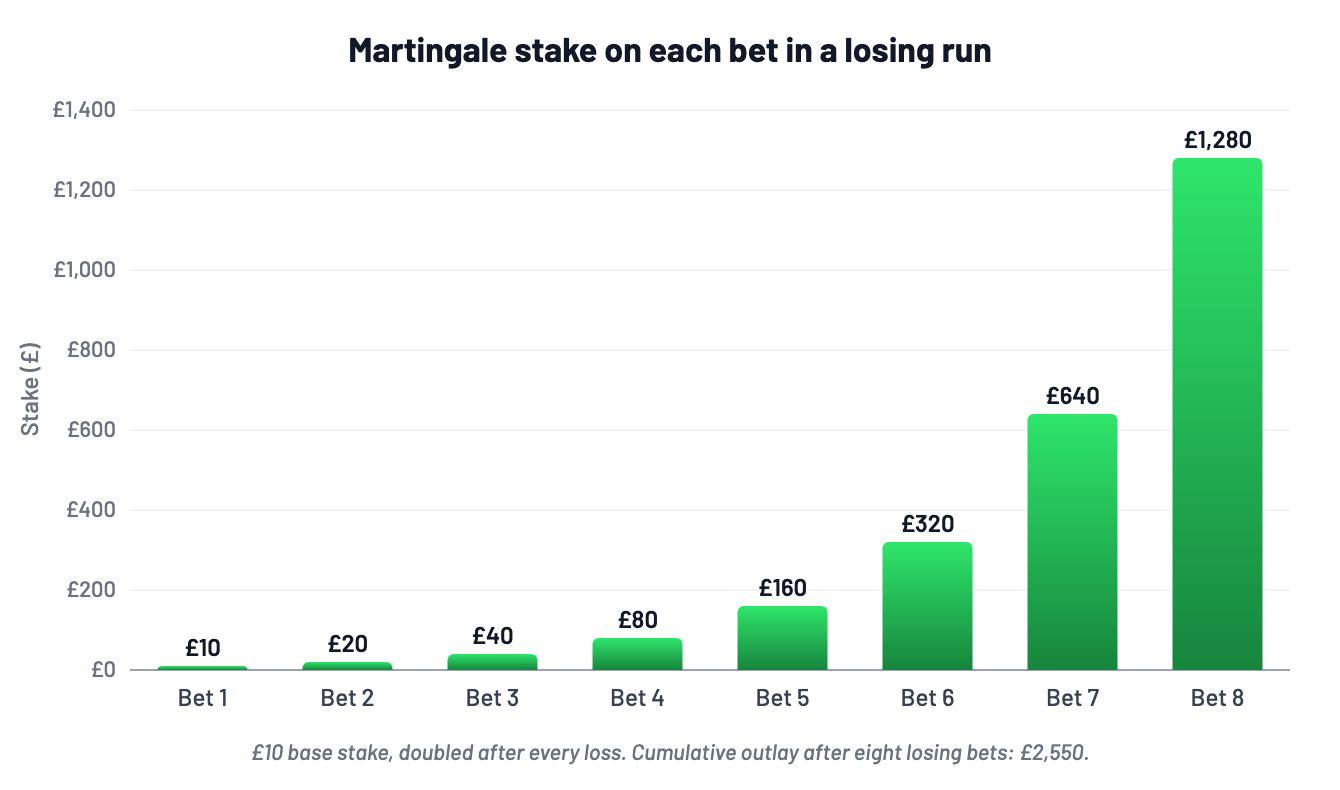
From a £10 base stake, eight consecutive losses demand a £1,280 stake and a cumulative outlay of £2,550 to chase back a £10 target.
From a £10 base, your eighth bet in a losing run requires £1,280, and by the time it settles you’ll have staked £2,550 chasing a £10 profit. The flaw isn’t the maths of a single recovery; it’s that your bankroll has a floor and the bookmaker has a maximum stake, and the sequence only needs to hit one of those. Eight straight losers at around even money happens roughly once in every 256 sequences, which across a winter of weekend bets is not remote.
Fibonacci applies the same idea with a gentler curve, stepping stakes through 1, 1, 2, 3, 5, 8 after losses. The 1-3-2-6 system goes the other way, raising stakes after wins across a 4-bet cycle and resetting after any loss. Both share the same flaw: they change the size of your stakes without changing the price you’re being offered. No staking pattern turns a negative-expected-value bet into a positive one.
Market selection is where strategy becomes practical, and it starts with the arithmetic of combining legs. Six selections, each with a genuine 80% chance, result in a full acca only 26.2% of the time (0.8^6). Cut it to 3 legs, and that rises to 51.2%. You give up the big return, but you take back control, and every leg you add multiplies the bookmaker’s margin along with the odds.
Singles and small multiples let you think properly about each selection instead of hunting a seventh name to round out the slip. Here’s where the main markets fit:
Two things often mistaken for strategy are really acca management tools. The first, acca insurance, is a promotion with conditions attached, usually a minimum number of legs and a refund paid as a free bet rather than cash. The second, cash out, is priced with the bookmaker’s margin applied a second time, so taking it early hands back value you have already earned. Neither is a reason to build a bet you wouldn’t otherwise place.
To put a proper case behind a selection, our guide to what a match preview should cover outlines the structure we use.
The winter calendar distorts football in ways an October form guide won’t capture. Premier League sides can play 3 fixtures within 8 days around Boxing Day and the New Year, and the Premier League schedule squeezes them into tight turnarounds. Deep squads cope. Squads relying on 11 first-choice players do not, and the gap between a strong side and a mid-table one narrows when both are on their third match in a week.
Rotation around European nights is the second factor. Clubs in the Champions League or Europa League regularly change 4 or 5 starters either side of a midweek trip, and a Thursday away fixture followed by a Sunday lunchtime kick-off is the toughest combination in the calendar.
January brings the FA Cup third round, the stage at which Premier League and Championship clubs enter the competition per The FA. Lineups change significantly, youth players get minutes, and the historic form lines between the two clubs no longer apply. The transfer window matters too: squads lose key players mid-month, and markets can be slow to reprice a side that has just sold its main goalscorer.
Then there’s the weather. Postponements and abandonments are a feature of December and January, particularly below the Premier League. If a leg in your acca is postponed, it is typically voided, with the remaining legs settling at reduced odds, but settlement windows can range from 48 hours to 14 days depending on the operator.
Read your bookmaker’s rules on abandoned and postponed matches rather than assuming they all work the same way.
A research process doesn’t need to take an hour. It needs to be the same every time, so your records mean something. This is the checklist we work through:
That last step is the one people skip. A favourite at 1.20 implies an 83.3% probability. Back 10 of those across a winter at £10 a time and you need 9 to land to break even. One dropped point against a relegation side on a frozen pitch wipes out the other 9. At short odds, the price often doesn’t reward the risk.
You cannot tell whether a football betting strategy is working without data, and almost nobody logs their bets. A spreadsheet is enough. Record the date, match, market, selection, stake in units, odds taken, closing price, result, and profit or loss. It takes around 30 seconds per bet.
The closing price column is the valuable one. Closing line value means comparing the odds you took with the final price before kick-off. If you consistently take 2.20 on selections that close at 2.00, you’re finding value before the market corrects, and that shows up in your records long before it shows up in your balance.
Be realistic about sample size. 50 bets tell you close to nothing; 500 starts to tell you something. Your records also fix a memory problem every punter has: you’ll remember the six-fold that went down on the last leg and forget the 15 that died on leg two. It’s why every selection in our football accumulator tips carries the numbers and reasoning behind it, because a tip without a rationale gives you nothing to learn from.
Set your budget before the season, not weekend by weekend, and treat it as money you’re prepared to lose entirely. A monthly figure you’d be comfortable spending on any other hobby is the right benchmark.
Every bookmaker licensed by the Gambling Commission must offer deposit limits, reality checks, and time-outs within your account settings. Use them. Setting a deposit limit when you’re calm is far easier than stopping when you’re not.
Never chase losses. A losing run is a reason to step away, which is the opposite of what progressive staking systems encourage. If betting has stopped being enjoyable, GAMSTOP offers free, multi-operator self-exclusion across all GB-licensed online gambling sites.
BeGambleAware and GamCare offer free, confidential support, and the National Gambling Helpline on 0808 8020 133.
18+ only. Betting Village is not a bookmaker. Everything we publish reflects our own opinion and should not be relied upon, so always do your own research before placing a bet.
Price, stake, record. Get those three right, and you have a football betting strategy worth the name. The next step is to apply them to real selections, with the numbers already done for you. Put the strategy into practice with our free football accumulator tips, posted by 9 pm the night before where possible, with the stats and reasoning behind every pick laid out so you can judge them yourself.
Betting should be fun. 18+. Gamble responsibly. begambleaware.org.
It’s the idea that roughly 80% of your returns come from about 20% of your bets or markets. Punters use it as an argument for narrowing their focus, betting on leagues and markets they know well rather than every fixture on the coupon. Treat it as a rule of thumb for discipline, not a tested statistical law.
Between 1% and 2% suits most recreational punters, with 5% as an upper ceiling. On a £200 bankroll, that’s £2 to £4 per bet. At that level, a run of 10 losers costs under a fifth of your pot, leaving you enough to keep applying your process.
The affected leg is usually voided, and your remaining legs settle at the reduced odds, so a five-fold becomes a four-fold. Settlement windows differ by operator, commonly between 48 hours and 14 days before the void applies. Always check your bookmaker’s postponed and abandoned match rules, as they are not identical.
A unit is a fixed percentage of your bankroll used as your standard stake. On a £500 bankroll at 2%, 1 unit equals £10. Recording stakes in units rather than pounds lets you compare performance fairly across periods when your bankroll has grown or shrunk.
Variance is the natural swing in results around your expected return. Back 10 selections each with a genuine 50% chance and you might get 2 winners or 8, without your judgement being wrong either way. It’s why short-term results tell you very little about whether your process is sound.