




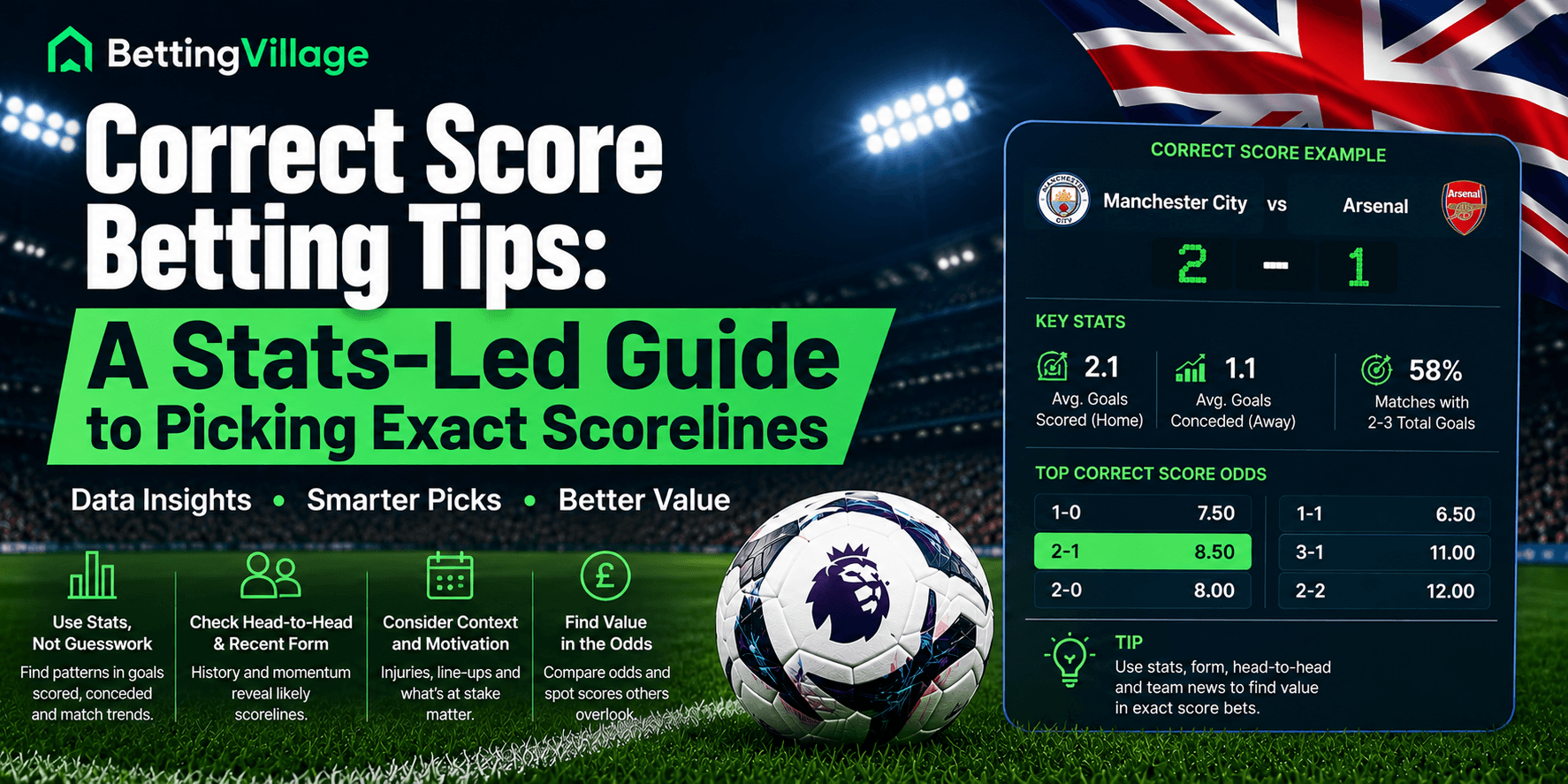
The correct score market pays some of the biggest single-match odds you will see, and that is exactly why it draws recreational bettors in. If you want correct score betting tips that go beyond copying a one-off pick from our daily tips, this guide walks through how the market prices up, why it is so hard to hit, and the repeatable, research-led methods used to find value in exact scorelines.
Correct Score Betting Explained
Correct score betting is a market where you predict the exact final scoreline of a football match, and the bet only wins if that precise score is correct. Back 2-1 and the game ends 2-0, and your stake is gone. It settles on 90 minutes plus stoppage time, not extra time or penalties, unless a bookmaker states otherwise.
That single condition makes it far tougher than the result (1X2) market, where a home win covers 1-0, 2-0, 3-1, and every other winning margin. It is also stricter than over/under goals or both teams to score, both of which group many scorelines into one outcome. Correct score isolates one result, so it is a high-variance market with a low strike rate by design.
A reminder before we go further: Betting Village is not a bookmaker, and everything here reflects our personal opinions on how the market works. Always do your own research before placing a bet.
High Correct Score Odds
Correct score odds are high because a single football match has dozens of plausible final scores, so probability is spread thinly and each individual scoreline is priced long. A game could realistically finish 0-0, 1-0, 2-1, 1-1, 3-2 or a dozen other ways, and the bookmaker has to price every one. No single score commands a big share of the probability, so even the most likely outcome rarely trades shorter than around 5/1.
Set your expectations honestly. Even a well-researched read lands infrequently. The reward for that low hit rate is the price, so correct score is a long-run value question, not a strike-rate contest. You are trying to back scores that are priced longer than their true probability, and accept plenty of near misses along the way.
The table below shows illustrative odds for common scorelines in a fairly even Premier League fixture. Prices vary by bookmaker and match, so treat these as a sanity check for what a fair price looks like, not a guaranteed return.
| Scoreline | Typical odds | Notes |
|---|---|---|
| 1-0 | 7/1 | Often shortest when a favourite faces a defensive side |
| 2-1 | 8/1 | Common in open, mid-table fixtures |
| 1-1 | 6/1 | Frequently one of the shortest prices in even games |
| 0-0 | 10/1 | Value in low-xG, two-strong-defence matchups |
| 2-0 | 9/1 | Favourite-to-nil lines often shorter than the draw |
Notice that favourites-to-nil scores such as 2-0 and 1-0 are often shorter than high-scoring lines, because clean sheets from strong sides are more predictable than five-goal thrillers.
Repeating Correct Score Strategy Methods
Yes, there are repeatable correct score strategies, and they all start with narrowing the field of candidate scores before you look at the odds. Here are the three methods we lean on most, each with a worked example.
Method 1: Target Low-Scoring Fixtures
The fewer goals a game is likely to produce, the fewer plausible scorelines there are, which shortens the list to cover. Fixtures with two strong defences, low expected goals, and a history of tight results are the ones to target. Picture a Championship clash between two organised, defensively sound sides averaging under 2.2 goals per game between them, where the realistic scores collapse to 0-0, 1-0, 0-1, and 1-1. Backing 1-0 and 0-0 gives two well-priced shots at a low-noise game rather than guessing at a wide-open shootout.
Method 2: Use Expected Goals (xG) and Recent Scoreline Patterns
Expected goals measure the quality of chances a team creates and concedes, giving a truer picture of scoring than the raw result. A plain-English breakdown of the metric is available in The Analyst’s guide to expected goals. To turn xG into candidate scores, take each side’s attacking xG and the opponent’s defensive record, then look at how those numbers tend to distribute across a match. Say Team A projects to around 1.6 goals and Team B to around 0.8, that points strongly toward 1-0, 2-0, and 2-1 as the core cluster, with 1-1 as the hedge. This is the same logic that underpins Poisson-style goal models, which spread a team’s expected goals across likely outcomes, just applied without the heavy maths. Pairing the xG read with recent scoreline patterns, such as Team A having won 2-0 or 2-1 in four of its last six home games, reinforces the cluster further.
Method 3: Cover Multiple Scorelines (Dutching)
Dutching means backing several scorelines in the same match to raise the strike rate, accepting a smaller net return when one lands. The trade-off is real and worth doing the maths on. Suppose a £10 total stake is split across three scores: £4 on 1-0 at 7/1, £3 on 2-0 at 9/1, and £3 on 2-1 at 8/1. If 1-0 lands, the return is £32 for a £22 profit; if 2-0 lands, £30 for £20; if 2-1 lands, £27 for £17. That gives three ways to win instead of one, but every winning outcome nets less than a single £10 punt on the correct score would. Spread across too many scores and the returns stop covering the stake, so it’s worth keeping it to two or three of the strongest candidates.
Whichever method you use, always confirm team news and expected line-ups before locking a score in. A rested striker, a rotated back four or a suspension can move a projected 2-0 to a 1-1 in an instant.
Correct Score in Accumulators and Scorecast Markets
Correct score selections make accumulator odds balloon quickly because you are multiplying long individual prices together. Two correct score legs at 7/1 and 8/1 already combine to around 71/1, so a three or four-fold becomes a lottery ticket rather than a considered bet. That is not automatically bad, but you should treat it as a small-stake speculative punt, not a core play.
Scorecast markets combine first goalscorer with correct score in one bet. The price is huge because you are asking two low-probability things to happen together, so the value question gets even harder. When you want the drama of scorelines without the strike-rate collapse, it often makes more sense to pair a correct score read with lower-variance goals markets in a mixed acca.
If you like the goals angle, our over 2.5 goals accumulator selections give you a softer landing than stacking exact scores. You can also build a broader matchday slip from our football accumulator tips, or lean into a result-and-goals blend with our teams to score and win accumulator tips. As a rule, keep no more than one correct score leg in any multiple.
Trading the Correct Score Market In-Play (Advanced)
This section is for more experienced bettors. Trading the correct score market in-play means backing and laying scorelines on a betting exchange as the game develops, rather than settling one pre-match bet. An early goal reshapes every scoreline price instantly: if you backed 0-0 before kick-off and the game is still goalless at half time, its price shortens sharply, and you can use cash out or lay off part of your position to lock in a green-up regardless of the final result.
This is higher effort and involves watching the match with an exchange open, so it is not required for the core strategy above. Treat it as an optional route once you are comfortable with pre-match selection, not a starting point.
Staking and Bankroll for a High-Variance Market
Correct score is a small-stake, high-odds market, not a foundation for your staking plan. Because the strike rate is low, flat, small unit stakes suit it best. Set a fixed amount you are comfortable losing on each scoreline, keep it to a fraction of what you would put on a shorter-odds bet, and expect losing runs to be normal rather than a signal something is wrong.
We describe probability here, never financial risk, and we will never call any bet low risk or risk-free. A well-priced 1-0 shout still misses far more often than it lands. Never chase losses by increasing stakes after a barren run, and never fund a correct score punt with money you cannot afford to lose. For free tools to keep your play in check, the guidance at BeGambleAware is a sensible first stop. Betting should be fun. Gamble responsibly. 18+ only. begambleaware.org.
Common Correct Score Betting Mistakes to Avoid
Most losing correct-score seasons come down to a handful of repeated errors. Watch for these:
- Chasing big, dramatic scorelines such as 4-3 or 3-2 purely because the odds look tempting. High goal counts are rare and unpredictable.
- Ignoring confirmed team news. Rotation, injuries and suspensions change the projected score, so never bet before line-ups are known.
- Overloading accas with several correct score legs, which turns a considered bet into a near-impossible one.
- Dutching too many scores until your winning returns no longer cover the combined stake.
- Betting the same fixture live and pre-match without a plan for how the two positions interact.
- Copying daily tips blindly without understanding the read behind the pick.
Looking for Today’s Correct Score Tips?
This page is an evergreen strategy guide, not a daily predictions feed, so you will not find today’s fixtures listed here. That is deliberate: we keep our method separate from our match-by-match picks so the strategy stays clean and reusable. When you want current selections, head to our live tips and goals accumulator content, where we apply exactly the low-xG, niche-fixture thinking covered above to that day’s games.
Turn a correct score read into a fuller matchday bet with our goals accumulator tips. Once you have shortlisted a scoreline, our latest goals accumulator picks show how we pair it with lower-variance goals markets to build a smarter slip. Betting should be fun. Gamble responsibly. 18+ only. begambleaware.org.
Correct Score Betting: FAQs
What is correct score betting and how does it settle?
Correct score betting is a market where you predict the exact final scoreline of a football match, and the bet only wins if that precise score is correct. It settles on 90 minutes plus stoppage time, not extra time or penalties, unless a bookmaker states otherwise. Back 2-1 and the game ends 2-0, and your stake is gone.
Why are correct score odds so high?
Correct score odds are high because a single football match has dozens of plausible final scores, so probability is spread thinly and each individual scoreline is priced long. No single score commands a big share of the probability, so even the most likely outcome rarely trades shorter than around 5/1. The reward for the low hit rate is the price.
Are there any repeatable strategies for correct score betting?
Yes, there are repeatable correct score strategies, and they all start with narrowing the field of candidate scores before you look at the odds. The three we lean on most are targeting low-scoring fixtures, using expected goals and recent scoreline patterns, and covering multiple scorelines through dutching. Each works best when paired with confirmed team news.
Can you actually make money with correct score bets?
Correct score is a long-run value question, not a strike-rate contest. Even a well-researched read lands infrequently, so success comes from backing scores priced longer than their true probability and accepting plenty of near misses. Treat it as a small-stake, high-odds market rather than a foundation for your staking plan.
How does covering multiple scorelines (dutching) affect your returns?
Dutching means backing several scorelines in the same match to raise your strike rate, accepting a smaller net return when one lands. If you split £10 across three scores, you gain three ways to win, but every winning outcome nets less than a single £10 punt would. Spread across too many scores and the returns stop covering your stake, so keep it to two or three strong candidates.
How do you use xG to narrow down likely scorelines?
Expected goals measures the quality of chances a team creates and concedes, giving a truer picture of scoring than the raw result. Take each side’s attacking xG and the opponent’s defensive record, then look at how those numbers distribute across a match to build a core cluster of candidate scores. This is the same logic that underpins Poisson-style goal models, applied without the heavy maths.
How should you stake on a high-variance market like correct score?
Correct score is a small-stake, high-odds market, not a foundation for your staking plan. Because the strike rate is low, flat, small unit stakes suit it best, kept to a fraction of what you would put on a shorter-odds bet. Never chase losses by increasing stakes after a barren run, and never bet with money you cannot afford to lose.