




If you have spotted the word “treble” on your bet slip and want to know what it means before you stake anything, this guide covers it. A treble sits neatly between a single, a double, and a full accumulator, and it is one of the simplest football multiples to place once you see how the odds stack up. This guide walks through the mechanics and includes a worked example, so the maths is easy to copy yourself.
Treble Bets Explained
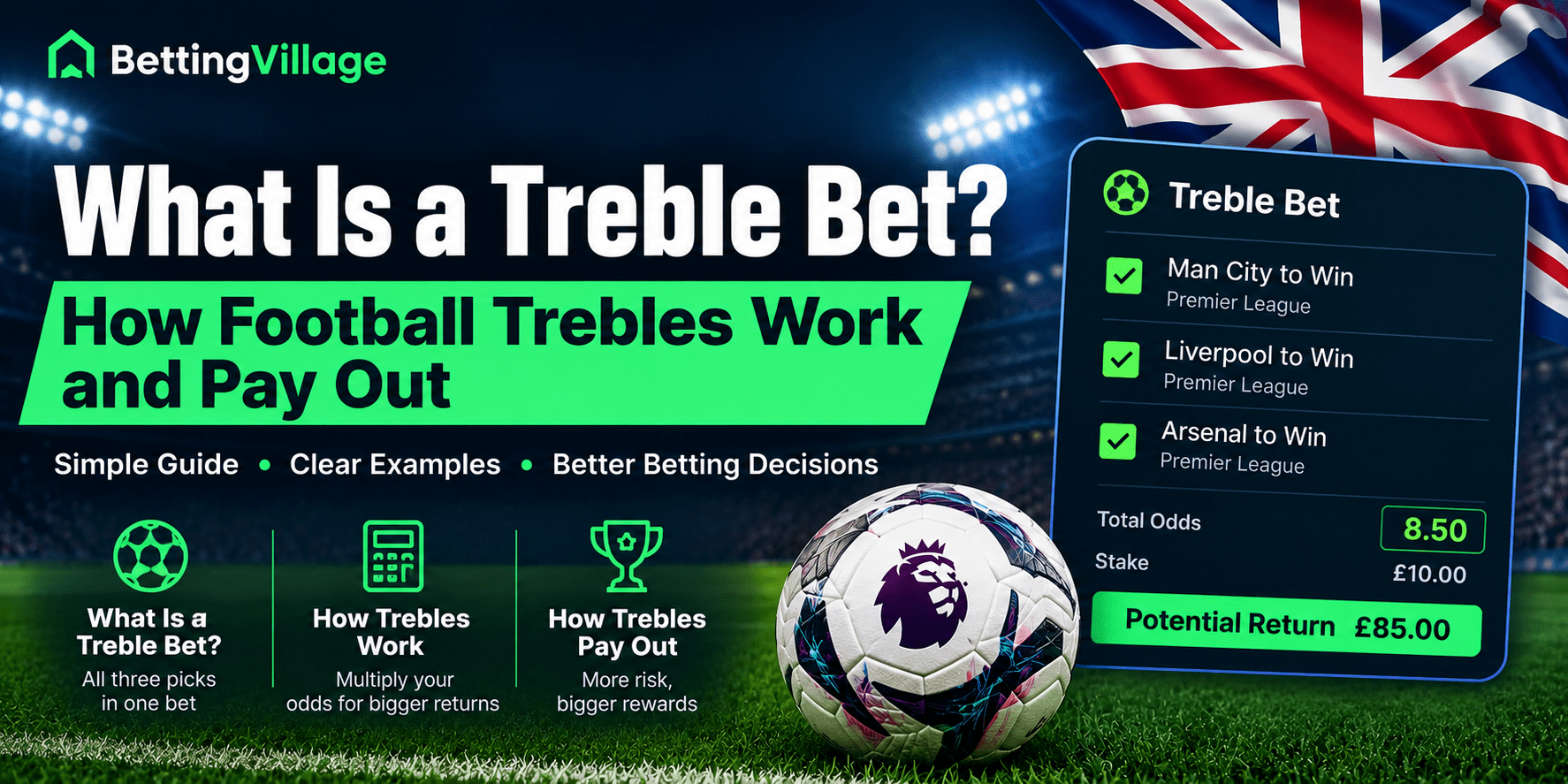
A treble bet is a single bet placed on three separate selections, where all three must win for the bet to return anything. It combines three events into one wager, and the odds of each leg are multiplied together to give bigger potential returns than a single or a double. If even one of the three selections loses, the whole treble loses.
It is important to understand this is one bet, not three. You pay one stake, and that stake rides across all three legs. The trade-off is straightforward: you get larger combined odds than backing any leg on its own, but every selection has to come in.
How It Works
A treble works by rolling the winnings from each leg onto the next. The odds are multiplied together, not added. When your first selection wins, your returns from that leg become the stake on the second selection. When the second wins, everything rides on the third. Only when all three land does the bet pay out.
This is why a treble produces a bigger return than three separate singles on the same odds. The compounding effect stacks up quickly. It is also why the risk is higher: all three legs must win, and there are no consolation returns if one lets you down, unlike some system bets such as a Trixie or a Patent.
You can build a treble from any three unrelated events. Football fans often pair three match outcomes, or combine markets like a match result with two both teams to score tips selections, provided the events are independent of one another.
Football Treble Bet Example
Here is a worked example using three Premier League selections with decimal odds and a £10 stake. Every figure below is an illustration to show the method, not a typical or expected return.
| Selection | Market | Decimal odds |
|---|---|---|
| Leg 1 | Home win | 1.80 |
| Leg 2 | Away win | 2.00 |
| Leg 3 | Over 1.5 goals | 1.50 |
To find the combined odds, multiply the three prices together:
- 1.80 x 2.00 = 3.60
- 3.60 x 1.50 = 5.40 combined odds
Now apply the £10 stake: 5.40 x £10 = £54 total return. That total includes the original £10 stake, so the profit is £54 minus £10, which comes to £44. If any one of the three legs loses, the return is nothing.
If a bookmaker shows fractional odds on the slip, convert them to decimals first. Divide the numerator by the denominator and add one: 4/5 becomes 1.80, evens (EVS) becomes 2.00, and 1/2 becomes 1.50. Those are exactly the three prices used above.
Working Out a Treble Bet Return
To work out a treble return, multiply all three decimal odds together, then multiply that figure by your stake. The result is your total return, stake included. Subtract the stake to find your profit.
Here is a second, quick example with different prices. Say your legs are 2.50, 1.60 and 1.40 on a £5 stake:
- 2.50 x 1.60 x 1.40 = 5.60 combined odds
- 5.60 x £5 = £28 total return
- £28 minus the £5 stake = £23 profit
Online treble calculators will do this instantly, but knowing the manual method means you can check a slip before you place it and understand exactly where the number comes from. Remember: the total return always includes your stake back, while profit does not.
Treble Bet vs. Accumulator
The difference comes down to the number of selections: a treble is a fixed three-selection multiple, while an accumulator, often shortened to “acca,” is a multiple of four or more selections. Both bet types work the same way, and both require every single leg to win.
Think of it as a ladder of multiples:
- Double: two selections, both must win.
- Treble: three selections, all three must win.
- Accumulator: four or more selections, all must win.
The more legs you add, the higher the combined odds climb, but the lower your chance of landing the bet becomes. A treble is often the sweet spot for punters who want bigger odds than a double without stretching to five or six legs. If you fancy scaling up from three legs, our stats-backed football accumulator tips give ready-made multiples with the reasoning behind each pick.
Each-Way Trebles Explained
An each-way treble is effectively two trebles in one: a win treble and a place treble. Each of your three selections carries a win part and a place part, so the stake is doubled. A £5 each-way treble costs £10 in total, £5 on the win side and £5 on the place side.
The win part pays only if all three selections win. The place part pays if all three at least place, at reduced odds based on each event’s place terms, and those terms vary by race field size and bookmaker, so always check the each-way fraction before staking. Each-way trebles are far more common in horse racing than in football, where win and goal markets dominate.
When to Use a Treble Bet
A treble suits you when you have three selections you genuinely fancy and want a bigger combined price than a single or double, without the long-shot odds of a five-leg acca. It is a balance between reward and probability, and it is worth weighing up honestly before you place one.
Pros
- Higher combined odds than a single or a double from the same selections.
- A small stake can produce a larger potential return.
- Simple to build and place on any bet slip.
Cons
- One losing leg loses the whole bet, with no consolation return.
- Higher risk than backing three singles separately.
- Harder to land than a double, since you need all three legs to win.
Our approach is to build treble legs around recent form, head-to-head records and goal trends rather than chasing obvious names, so each selection has a stated reason behind it.
Betting should be fun. Gamble responsibly, 18+ only. Betting Village is not a bookmaker, and all tips reflect personal opinions, so always carry out independent research before placing any bet.
Treble Bets: FAQs
What is a treble bet?
A treble bet is a single bet placed on three separate selections, where all three must win for the bet to return anything. It combines three events into one wager, and the odds of each leg are multiplied together to give bigger potential returns than a single or a double. If even one of the three selections loses, the whole treble loses.
How many selections are in a treble bet?
A treble has three selections placed as one bet. You stake once, and that single stake covers all three legs across three separate events.
Do all selections have to win in a treble?
Yes. All three selections must win for a treble to return anything. A single losing leg means the entire bet loses, with no partial payout.
Can you place a treble across different sports?
Yes. As long as the three events are unrelated, selections can be combined from football, racing, darts, or any other sport into one treble. Most bookmakers allow this on a single slip.
How does a treble bet work?
A treble works by rolling the winnings from each leg onto the next, so the odds are multiplied together rather than added. When the first selection wins, those returns become the stake on the second, and so on across all three legs. The bet only pays out when all three selections land, and there are no consolation returns if one lets you down.
What’s the formula for working out a treble payout?
Multiply all three decimal odds together, then multiply that figure by the stake to find the total return. For example, 1.80 x 2.00 x 1.50 gives combined odds of 5.40, and a £10 stake returns £54 in total. That total includes the stake back, so subtracting it gives the profit.
Is a treble the same as an accumulator?
Not quite. A treble is a fixed three-selection multiple, whereas an accumulator covers four or more selections. The mechanics are otherwise identical, both pay at combined odds, and both need every single leg to win.
What is an each-way treble?
An each-way treble effectively runs two trebles at once: a win treble and a place treble. Each selection carries a win part and a place part, doubling the stake. The place side pays out if all three selections at least place, at reduced odds set by each event’s place terms, a structure that shows up far more often in horse racing than in football.
Is a treble bet worth it?
It depends on the selections. A treble suits punters with three picks they genuinely fancy who want a bigger combined price than a single or double offers, without stretching to the long-shot odds of a five-leg acca. It comes down to weighing reward against probability honestly before placing one.
Browse Our Latest Accumulator and Treble Tips
Find selections worth backing. Browse our stats-backed football accumulator tips for more multiple ideas, each one backed by a stated reason, and load your favourites straight to your bet slip.
Betting should be fun. Gamble responsibly, 18+ only, begambleaware.org.