




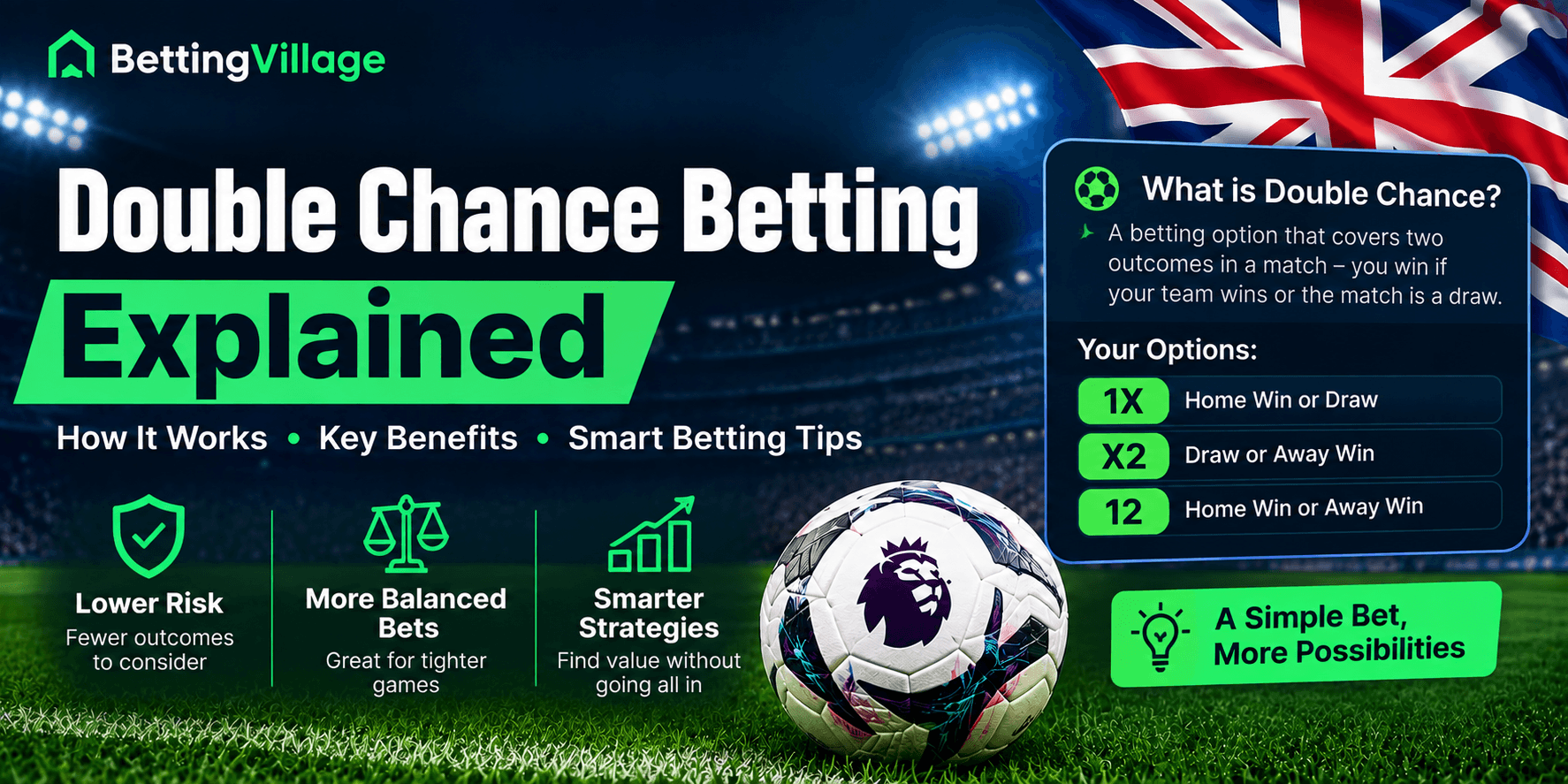
Double chance betting is one of the simplest ways to cover more of what can happen in a football match, and it turns up constantly on our tip pages when a straight match result pick feels a stretch. If you have seen 1X, 12, or X2 next to a fixture and wondered what you are actually backing, this guide breaks the market down, shows the odds trade-off with real numbers, and explains when we think double chance betting earns its place on a bet slip.
How It Works
Double chance is a football bet covering two of the three possible match outcomes (home win, draw, away win) on a single selection, so the bet wins if either of the two covered outcomes happens. It sits on the standard 1X2 (match result) market, the same three outcomes you would weigh up in a football match preview, and is harder to lose than a straight win bet, because only one of the three results can beat it. The three shorthand variants are 1X, 12, and X2, broken down next.
The Three Double Chance Options
Each variant pairs two of the three match-result outcomes. Check the table below to see what each covers, and the kind of fixture where each tends to appear.
| Variant | What it covers | Example scenario |
|---|---|---|
| 1X | Home win or draw. Loses only if the away side wins. | A home favourite you expect to at least avoid defeat, such as a mid-table side hosting a struggler. |
| 12 | Home win or away win, with no draw covered. Loses only on a level result. | An open, attacking derby where you expect a winner but cannot call which side. |
| X2 | Draw or away win. Loses only if the home side wins. | A strong away favourite travelling to a weaker home side, where you want the draw covered too. |
The key thing to remember is that 12 is the only variant that does not cover the draw, so it loses on any level scoreline, no matter how the goals arrive.
You can confirm the same market definition on the bet365 help centre.
The Trade-Off: Lower Risk, Shorter Odds
Because double chance covers two outcomes instead of one, the odds shorten sharply against a standard match-result bet. You are backing a result that is more likely to land, so your bookmaker prices it accordingly.
Take a home favourite priced at 2.50 to win outright. The same side on a 1X double chance (win or draw) might sit around 1.40 on the bet slip. That 1.40 price reflects a much higher implied chance of the selection landing, roughly 71% against the 40% implied by the 2.50 win price. You are paying for that extra security by giving up a large slice of the potential return.
That is the honest trade at the heart of the market. You cover more outcomes, so the price falls. Whether that shorter price is worth taking depends entirely on how likely the uncovered result actually is, which is where reading form and result trends matters more than the label on the market.
Double Chance Worked Example
Say a home favourite is priced at 1.40 on 1X, covering a home win or a draw. A £10 stake at 1.40 returns £14 in total, which is your £10 back plus £4 profit. The maths is simply £10 x 1.40 = £14.
The only result that loses this bet is an away win. A home victory settles it as a winner, and so does a draw, whether that is 0-0 or 3-3. If the visitors take all three points, the £10 is lost.
Compare that with backing the straight home win at 2.50. A winning £10 there returns £25, far more than £14, but a draw would lose that bet outright. The double chance settles the moment full time is reached, and the difference between the two returns is exactly what you pay for covering the draw as well. This is an illustrative example, not a typical return.
When a Double Chance Bet Loses
Covering two of the three outcomes lowers the number of results that beat you, but it is not certain. A double chance bet loses whenever the single uncovered outcome happens:
- 1X loses on an away win.
- X2 loses on a home win.
- 12 loses on a draw.
Football throws up upsets every weekend, so a well-reasoned double chance selection can still come unstuck. Treat it as a way to reduce how many results beat you, not as a shortcut around the outcome you did not cover.
Draw No Bet vs Double Chance
Draw no bet and double chance are often confused, but they settle differently. With double chance 1X, you win if the home side wins or draws. With draw no bet on the home side, a draw voids the bet and returns your stake, so you only profit on a home win and simply get your money back if the match ends level. Double chance pays out on the draw, whereas draw no bet just refunds your stake on it. Draw no bet usually carries a slightly longer price than the equivalent double chance, because it rewards you on fewer outcomes.
Value and Profitability
Double chance can be profitable, but only when the shorter price still holds value against the true chance of the result. A high hit rate on its own does not guarantee profit, because the odds are cut to reflect that higher chance in the first place.
Here is the trap. You could land eight 1X selections out of ten and still lose money if you kept backing them at prices like 1.20 when the fair price was closer to 1.30. The two losers wipe out the thin margin on the eight winners. Strike rate and profit are not the same thing.
At Betting Village we judge a double chance pick on the same basis as any market: the form of both sides, home and away splits, and how often the uncovered result has actually happened in similar fixtures. If the price does not reward the risk of that one outcome, we leave it. No market pays out just because it feels safer.
Double Chance Betting for Beginners
Double chance suits newer bettors well because it is easy to grasp. Once you can read the 1X2 market, you can read double chance, and covering two of three outcomes means fewer results go against you than a straight win bet. That can make the market feel more forgiving while you learn how fixtures tend to play out.
The catch is the shorter odds. Fewer losses are fine, but the reduced return means this is not easy money, and beginners should not treat it that way. Use it to understand how the match result market behaves before trying bigger-priced multiples like our European football accumulator tips.
When It Makes Sense (and When It Does Not)
The market is at its best when the draw or one specific result is a genuine threat you want to insure against. It is a common feature of our football accumulator tips: a single leg can hold a whole acca together.
Double chance tends to make sense when:
- A strong favourite is playing away from home, where X2 covers both a win and a hard-fought draw.
- You are looking at a cup tie or cagey fixture where a draw is a live possibility, so 1X or X2 keeps you in.
- You want a steadier leg inside an accumulator, replacing a full match-result pick that feels too risky on its own.
It works less well when:
- You stack several short double chance legs into a multiple, because the cut prices erode value quickly across the accumulator.
- You back an already heavy home favourite, where the 1X price can drop so low there is almost nothing left to win.
- The uncovered result is more likely than the odds suggest, meaning you are overpaying for security.
Because the draw sits at the centre of both 1X and X2, it pairs naturally with how we build our draw accumulator tips, where result trends do the heavy lifting. The point that matters most is this: let the data pick the market, not habit. Double chance is a tool, not a default.
Double Chance Pros and Cons
A quick summary if you are weighing the market up.
- Pros: covers two of three outcomes, a higher hit rate than a straight win bet, simple to understand, and useful for steadier accumulator legs.
- Cons: shorter odds, reduced value inside multiples, still capable of losing on the one uncovered result, and weak value on heavy favourites.
In short, double chance suits bettors who want to reduce how many results beat a selection and are comfortable trading return for a higher chance of the bet landing, as long as the price stacks up against the true odds of that uncovered outcome.
Build a Steadier Acca Around Double Chance
Now you know how 1X, 12, and X2 work, take a look at our teams to score and win accumulator tips to see how we build steadier acca legs backed by form and result trends.
Double Chance Betting: FAQs
What is double chance in betting?
Double chance is a football bet covering two of the three possible match outcomes (home win, draw, away win) on a single selection. The bet wins if either of the two covered outcomes happens. It sits on the standard 1X2 match-result market and is harder to lose than a straight win bet because only one of the three results can beat it.
What does X2 mean in double chance betting?
X2 covers a draw or an away win on a single selection. It loses only if the home side wins. This variant tends to suit a strong away favourite travelling to a weaker home side, where you want the draw covered as well as the win.
Can you lose a double chance bet?
Yes. Covering two of three outcomes lowers how many results beat you, but it is not certainty. A double chance bet loses whenever the single uncovered outcome lands: 1X loses on an away win, X2 loses on a home win, and 12 loses on a draw.
Is double chance betting profitable?
It can be, but only when the shorter price still holds value against the true chance of the result. A high hit rate alone does not guarantee profit, because the odds are cut to reflect that higher chance. At Betting Village we judge a pick on form, home and away splits, and how often the uncovered result has actually happened in similar fixtures.
Is double chance betting good for beginners?
Double chance suits newer bettors because it is easy to grasp. Once you can read the 1X2 market, you can read double chance, and covering two of three outcomes means fewer results go against you than a straight win bet. The catch is the shorter odds, so it should not be treated as easy money.
Is draw no bet the same as double chance?
No. They settle differently. With double chance 1X you win if the home side wins or draws. With draw no bet, a draw voids the bet and your stake is returned, so you only profit on a home win. Draw no bet usually carries a slightly longer price because it rewards you on fewer outcomes.
When is double chance worth using?
Double chance tends to make sense when a strong favourite is playing away from home, in a cup tie or cagey fixture where a draw is a live possibility, or when you want a steadier leg inside an accumulator. It works less well on heavy home favourites where the price drops so low there is almost nothing left to win.