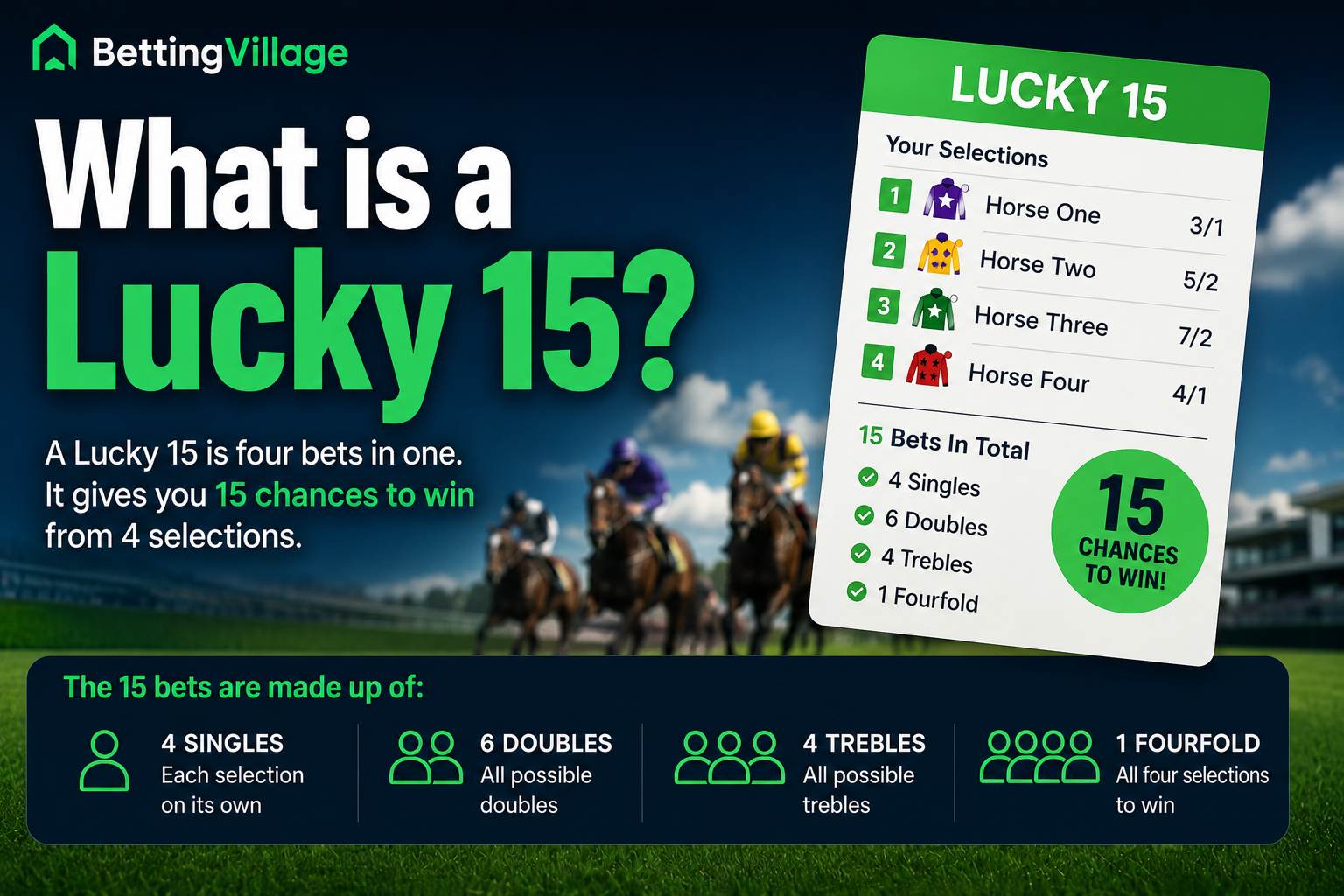
A Lucky 15 is a multiple bet made up of 15 separate bets across four selections: 4 singles, 6 doubles, 4 trebles and 1 four-fold accumulator. Because it includes those four singles, you only need one of your four selections to win to get a return. That single feature is what separates a Lucky 15 from a straight accumulator, where one losing leg wipes out the whole bet.
If you have backed a few horses at Cheltenham, you have probably seen the Lucky 15 option sitting on your bet slip and wondered whether it is worth the extra outlay. This guide walks through exactly how the bet is built, what it costs, how the returns are paid on one, two, three or four winners, and how the each-way version and bookmaker bonuses change the picture. We use real prices throughout so you can see the maths rather than just read the theory.
A Lucky 15 works by covering every possible winning combination of your four selections in a single bet. You pick four selections in four different events, for example four horses in four separate races or four teams across four football matches, and the bookmaker splits your bet into 15 individual wagers automatically. You do not place them one by one, and you cannot weight the stake towards the singles or the accumulator. Your unit stake is applied equally across all 15 bets.
The 15 bets inside a Lucky 15 break down like this:
That structure makes the Lucky 15 a full-cover bet. A full-cover bet includes every double, treble and accumulator available from your selections. The Lucky 15 goes one step further than a standard full-cover bet by adding the four singles, which is why a single winner still returns money. The permutations are fixed, so a Lucky 15 always contains exactly 15 bets, no matter which four selections you choose.
There are 15 bets in a Lucky 15, built from 4 selections. The name comes directly from the number of bets, not the number of selections, which is the single most common point of confusion worth clearing up: four selections, fifteen bets. The table below shows how those fifteen bets break down if we label the four selections A, B, C and D.
| Bet Type | Number of Bets | Combinations |
|---|---|---|
| Singles | 4 | A, B, C, D |
| Doubles | 6 | AB, AC, AD, BC, BD, CD |
| Trebles | 4 | ABC, ABD, ACD, BCD |
| Four-fold accumulator | 1 | ABCD |
| Total | 15 | All win and multiple combinations |
A Lucky 15 costs your unit stake multiplied by 15, so a £1 Lucky 15 costs £15, a 50p Lucky 15 costs £7.50, and a £2 Lucky 15 costs £30. The figure you enter on your bet slip is the stake per line, not the total, which catches a lot of people out the first time they place one.
That is the core trade-off with a Lucky 15. You are paying fifteen times your unit stake for the safety net of those singles. If you were happy to stake £15 on a straight four-fold instead, you would need all four to win, though your potential return would be far higher. Deciding between the two comes down to how confident you are that all four selections will land. The table below shows the total outlay at common unit stakes.
| Unit Stake | Win-Only Lucky 15 (15 bets) | Each-Way Lucky 15 (30 bets) |
|---|---|---|
| 25p | £3.75 | £7.50 |
| 50p | £7.50 | £15.00 |
| £1 | £15.00 | £30.00 |
| £2 | £30.00 | £60.00 |
| £5 | £75.00 | £150.00 |
The easiest way to understand a Lucky 15 is to work through one. Say it is a Saturday afternoon, and you fancy four horses across the card, each priced at 2/1 (3.00 in decimal odds). You place a £1 win-only Lucky 15, bringing your total stake to £15. Here is what happens depending on how many of your four horses win.
| Winners | Bets That Pay Out | Approx. Return (£1 stake, all 2/1) |
|---|---|---|
| 1 winner | 1 single | £3.00 |
| 2 winners | 2 singles, 1 double | £15.00 |
| 3 winners | 3 singles, 3 doubles, 1 treble | £63.00 |
| 4 winners | 4 singles, 6 doubles, 4 trebles, 1 four-fold | £240.00 |
Two things stand out from that table. First, one winner at 2/1 returns £3 from a £15 stake, so you are still £12 down. A single winner gets you a return, but rarely a profit unless that winner is at a big price. Second, the jump from three winners to four is substantial, because the four-fold accumulator only pays when every selection lands. That is where the real money in a Lucky 15 sits.
If you want to check figures for your own selections rather than do the maths by hand, most bookmakers and free tools online offer a Lucky 15 calculator that handles fractional odds, each-way terms, Rule 4 deductions and dead heats. It is worth running your slip through one before you place it, so your decision is based on the actual numbers for two and three winners, not just the hope of a four-timer.
An each-way Lucky 15 contains 30 bets, not 15, because each of your selections is backed to win and to place. It doubles the number of bets and doubles your total stake, so a £1 each-way Lucky 15 costs £30 (15 win bets plus 15 place bets at £1 each).
The each-way element acts as extra insurance. In a race with a large field, the odds of a horse placing are naturally higher than the odds of it winning outright, so if one of your horses finishes second or third rather than first, the place part of your bet can still return money. Place terms vary by race, but a typical arrangement is one-fifth of the odds for a horse finishing in the first three. This is the same each-way principle we apply when posting bigger-priced runners in our horse racing tips for Cheltenham, where field sizes are large, and placing is a realistic outcome.
As a general guide, short-priced selections around 5/1 or shorter are often better suited to a win-only Lucky 15. In contrast, longer-priced selections tend to favour the each-way version, because the place return gives you a cushion if they run well without winning. Bear in mind that the stake doubles, so a £1 each-way Lucky 15 should be treated as a £30 bet.
You do not need all four selections to win a Lucky 15. Because the bet includes four singles, a single winning selection guarantees a return, which is the core appeal of the bet and the main reason it is more forgiving than an accumulator. The more selections that win, the more the doubles, trebles, and four-fold come into play, and the returns climb quickly.
Here is how the payout logic works as your winners stack up:
Lucky 15 bonuses are promotions some bookmakers apply to boost your return, and they are a big part of why the bet is called “lucky”. There are two common types.
If only one of your four selections wins, some bookmakers pay you at enhanced odds on that single. Betfred is the market leader here, currently paying treble the odds (3x) on a lone winner from your Lucky 15 on horse racing and greyhound bets, meaning a lone winner at 4/1 would be paid as if it won at 12/1. Most other major UK bookmakers offer double the odds in the same situation. Always check the current terms with your bookmaker before placing a bet, as these promotions can change.
If all four of your selections win, many bookmakers add a bonus to your total return. Betfred currently offers 25% on top of total winnings when all four land, while bookmakers such as Betfair offer around 10%. Some apply this as a percentage boost to the whole return; others enhance the odds on the singles. Either way, it is an extra reward on top of an already strong payout when the full slip lands. These bonuses apply only to the win part of each-way bet, and specific terms differ between bookmakers, so treat the figures here as typical rather than guaranteed.
The difference between a Lucky 15 and an accumulator comes down to coverage and cost. A four-fold accumulator is one single bet on four selections, and all four must win for it to pay anything. A Lucky 15 covers the same four selections but adds the four singles, six doubles, and four trebles, so a single winner still returns money. The Lucky 15 is far more forgiving, but it costs 15 times your unit stake, whereas the accumulator costs just one unit. For a closer look at how the acca itself works, head to our football accumulator tips and guides.
A Yankee uses the same four selections as a Lucky 15 but contains only 11 bets: 6 doubles, 4 trebles, and 1 four-fold. It has no singles, which means you need at least two winners before a Yankee returns anything. A Lucky 15 is simply a Yankee with the four singles added, bringing the total to 15 bets. The Yankee is cheaper at 11 units versus 15, but the Lucky 15 gives you a return from just one winner and often qualifies for the one-winner and all-winners bonuses that a Yankee does not.
| Bet | Selections | Total Bets | Minimum Winners for a Return |
|---|---|---|---|
| Trixie | 3 | 4 | 2 |
| Patent | 3 | 7 | 1 |
| Yankee | 4 | 11 | 2 |
| Lucky 15 | 4 | 15 | 1 |
| Lucky 31 | 5 | 31 | 1 |
| Lucky 63 | 6 | 63 | 1 |
The table above places the Lucky 15 within a family of related bets. The Patent is its three-selection equivalent, the Lucky 31 steps up to five selections and 31 bets, and the Lucky 63 covers six selections across 63 bets. All of the “Lucky” bets include singles, so all of them can return from a single winner.
If one of your selections is a non-runner, most commonly a withdrawn horse, that selection is treated as void, and your Lucky 15 is recalculated around the three remaining selections. In practice, your bet effectively becomes a Patent on the other three: the single on the non-runner is refunded, the doubles containing it become singles, the trebles become doubles, and the four-fold becomes a treble. You do not lose the whole bet because one selection was pulled out.
A separate rule worth knowing is Rule 4. When a horse is withdrawn, and there is not enough time to form a new market, bookmakers apply a Rule 4 deduction to winnings on the remaining runners, because the odds on those runners no longer reflect the full field. The deduction is a set amount in pounds based on the odds of the withdrawn horse, ranging from 5p in the pound for a horse at 10/1 to 14/1, up to a maximum of 90p in the pound for a horse at 1/9 or shorter. A dead heat, where two selections finish level, also reduces the return on the affected bet, usually by dividing the stake according to the number of runners involved. These rules apply to a Lucky 15 in the same way they apply to any other bet.
A Lucky 15 tends to be worth it when you have four selections you genuinely fancy but are not confident enough to trust all four in a straight accumulator. It is popular at big meetings for good reason. If you are picking four horses across a Saturday card or across the first day of a festival, the singles give you a return even if only one comes in, and the bonuses can turn a modest slip into a strong result if you land three or four winners.
Where a Lucky 15 works against you is at short prices. As the worked example above showed, one winner at 2/1 returns £3 from a £15 outlay. If all four of your selections are short-priced favourites, the singles will not cover your stake unless several of them win, and the bet can start to feel expensive for what it returns. In that situation, a straight accumulator or a smaller Yankee may make more sense. Put simply, a Lucky 15 rewards a well-priced outsider landing far more than it rewards a slip full of odds-on shots.
A Lucky 15 spreads your risk across more bets, but it is still 15 bets, and the stake adds up faster than a single wager. Set a budget before you place one, treat the unit stake as fifteen times the number you enter, and never chase a losing slip. If gambling is not fun any more, free and confidential support is available from GambleAware and the National Gambling Helpline on 0808 8020 133, open 8am to midnight, seven days a week. You can also learn more about betting rules and bet settlement directly from the Gambling Commission. Betting Village is not a bookmaker, and all tips reflect our own opinions and should not be relied upon. 18+.
A Lucky 15 contains 15 bets built from 4 selections: 4 singles, 6 doubles, 4 trebles and 1 four-fold accumulator.
No, because a Lucky 15 includes four singles, one winning selection is enough to return money. The more selections that win, the more the doubles, trebles and four-fold pay out.
A £1 Lucky 15 costs £15, because your unit stake is placed on all 15 bets. A 50p Lucky 15 costs £7.50 and a £2 Lucky 15 costs £30. The each-way version doubles this.
A Lucky 15 is a full-cover multiple bet on four selections that covers every single, double, treble, and the four-fold accumulator, totalling 15 bets. The name refers to the number of bets.
Work out each of the 15 bets separately using your selections’ odds, then add the winning lines together. With four winners at 2/1, a £1 Lucky 15 returns around £240 before any bonus. A Lucky 15 calculator does this instantly.
An each-way Lucky 15 can be worth it when your selections are longer-priced and likely to place, as the place return offers a cushion against a non-winning run. It costs twice as much, so a £1 each-way Lucky 15 should be treated as a £30 bet.
Bookmakers that offer one-winner and all-winners bonuses give the best value on a Lucky 15. Betfred currently leads the market, paying treble (3x) the odds on a single winner and a 25% bonus when all four selections win. Always check the current terms before placing your bet.