If you have seen a 1+ or 2+ shots on target price next to a striker’s name and paused before staking, you are in the right place. Shots on target betting rewards you for reading a game the way we do at Betting Village: through shot volume, fixtures, and recent form.
This guide sets out exactly what counts, how the 1+, 1.5, and 2+ lines settle, and how we approach the market when we build our slips.
Shots on target betting is a market where you bet on how many efforts a team or player has that either hit the net or would have gone in without a goalkeeper save or a defensive clearance on the line. Both team and player versions exist. Goals count, saves count and shots cleared off the line count, but the total is measured across the full match unless you back a specific half market.
A shot on target is any goal-bound effort that beats every outfield player and is only stopped by the goalkeeper, the net or a clearance on the goal line. This is the definition that decides whether your bet wins, so it pays to be precise about the edge cases.
| Counts as a shot on target | Does not count |
|---|---|
| A goal scored in open play | An effort that hits the woodwork and stays out |
| An effort saved by the goalkeeper | A shot blocked by a defender who isn’t the last line, with cover still behind them |
| A shot blocked or cleared by the last defender on the line | A shot that goes wide or over the bar |
| A penalty scored or a penalty saved | An own goal (generally excluded) |
The distinction between a save and a block is the one that catches punters out. A save is made by the keeper, so it counts. A block by a centre-back sliding in front of the shot does not, because the effort never truly tested the goal. A clearance on the line is treated as on target because the ball was heading in. This mirrors the standard Opta football statistics definition that UK bookmakers use to settle these markets, so the same rules apply across sites.
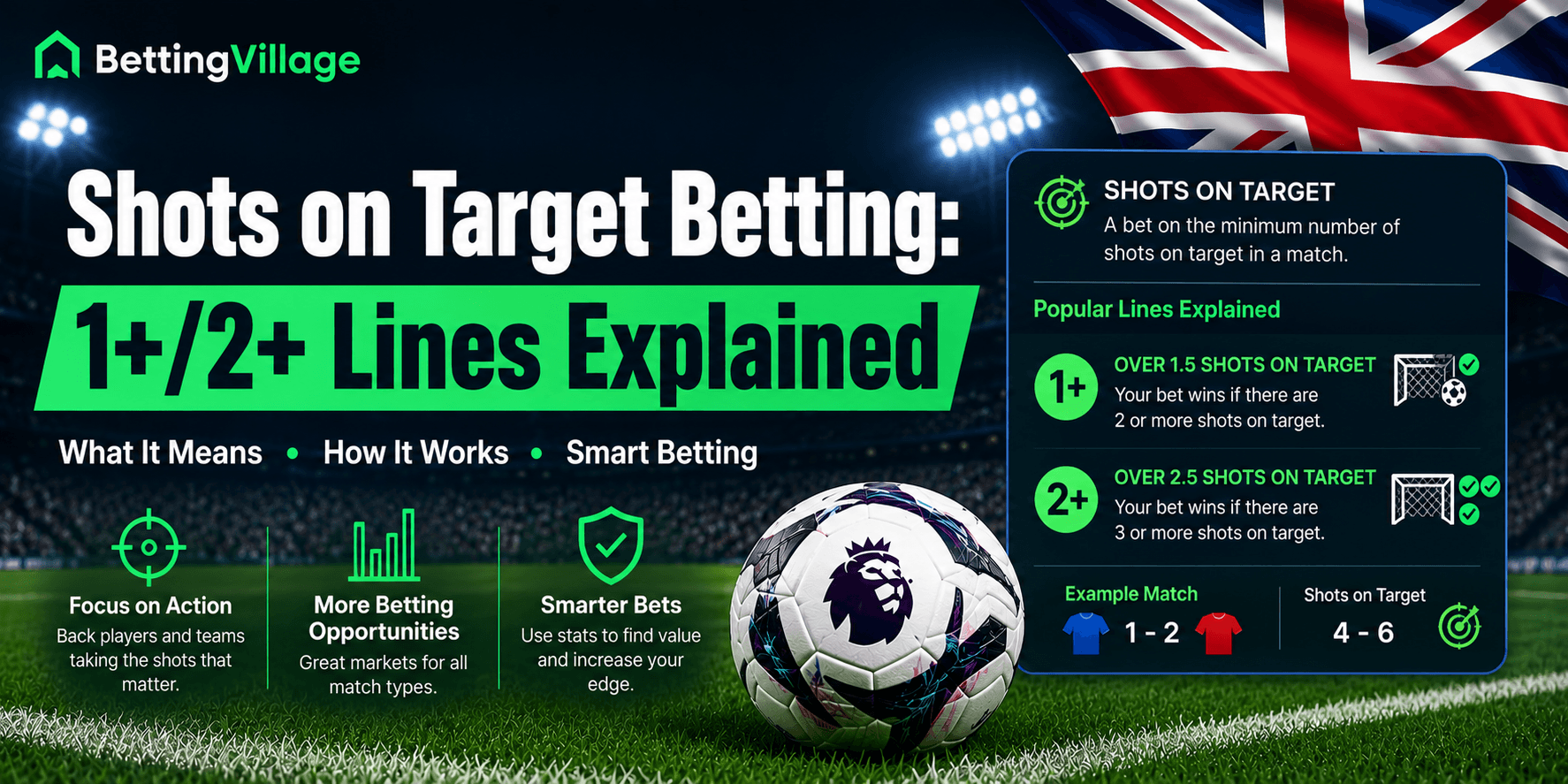
1+ shots on target means the player or team must record at least one shot on target for the bet to win. The plus sign means one or more, so 1+ does not mean two. A single on-target effort settles it as a winner, whether that is a goal, a save, or a clearance off the line. If a forward has one shot pushed round the post by the keeper, your 1+ bet lands even if that is his only attempt all match.
2+ shots on target means at least two on-target efforts are needed to win. To answer the common question directly: 2+ settles on two, not three. Two qualifying shots is enough, and any total above that still wins.
The 1.5 line trips people up because half a shot is impossible. A 1.5 shots on target line needs two on-target shots to win, since a player cannot record 1.5 of anything. In practice, over 1.5 and 2+ require the same outcome: two or more on target. The same at-least logic runs up the ladder, so a 3+ line needs three or more on-target efforts, and so on.
There are two broad families of shots on target bet, and knowing which you are backing changes how you should read the fixture.
It cover a whole side. You will see a match line for each team and over/under totals, for example, over 4.5 shots on target for the home side. These suit sides with heavy possession and a habit of testing the keeper, and they link neatly to goals-based markets. A team that racks up on-target shots often ends up in profitable territory for both teams to score tips, too, because volume tends to breed goals.
It focuses on one individual. The most common lines are 1+ and 2+, with 3+ available for the highest-volume forwards. These are the building blocks recreational punters use most, since a starting striker is a clear candidate to test the keeper at least once.
You will also find alternative lines such as shots from outside the box or first shot markets. Whatever the line, most UK bookmakers settle on official Opta data as the standard, so settlement is consistent from one site to the next and disputes are rare.
Say a regular starting attacker is priced around 4/6 to record 1+ shots on target against a mid-table side. This is an illustration only and not a prediction of a result.
You place a £10 stake at 4/6. If the player forces the keeper into a single save, or scores, or has an effort cleared off the line, the bet wins and returns £16.67 (your £10 stake plus £6.67 profit). One qualifying effort is all it takes.
Now the losing scenario. If that same player has two shots during the match but both are blocked by defenders in front of goal, and nothing else troubles the keeper, the bet loses. Blocks by outfield players do not count, so two blocked efforts settle as zero on target. The important nuance to remember is that a shot cleared off the line would still settle the bet as won, because the ball was goal-bound and only a defender on the line kept it out.
Our edge in this market comes from doing the homework rather than backing the biggest name on the teamsheet. Here is the checklist we work through before we like a shots on target selection.
Once you are happy with two or three player shots on target picks, they combine well. Folding several 1+ props together builds a healthy price, which is why we regularly weave them into our football accumulator tips when the fixtures line up. For daily selections across every market, you can browse our latest football tips and load your picks straight to your slip.
Like any market, shots on target has trade-offs. Here is our honest read on both sides so you can decide whether it suits your betting.
None of these lines is certain. We frame every selection around the stats we like and the fixtures that back them, never as a sure thing.
Once you know how the 1+ and 2+ lines settle, pair your player shot props with our goals accumulator tips and load your selections straight to your slip.
Betting should be fun. Gamble responsibly. 18+ only.
A shot on target is any goal-bound effort that beats every outfield player and is only stopped by the goalkeeper, the net or a clearance on the goal line. Goals, keeper saves and shots cleared off the line all count. Shots that hit the woodwork, are blocked by an outfield defender in open play, or go wide or over do not.
1+ shots on target means the player or team must record at least one shot on target for the bet to win. The plus sign means one or more, so 1+ does not mean two. A single qualifying effort, whether a goal, a save or a clearance off the line, settles it as a winner.
2+ shots on target means at least two on-target efforts are needed to win. It settles on two, not three, and any total above two still wins. Two qualifying shots is all it takes.
A 1.5 shots on target line needs two on-target shots to win, because half a shot is impossible. In practice, over 1.5 and 2+ require the same outcome: two or more on target.
A penalty scored or a penalty saved counts as a shot on target. A shot blocked by an outfield defender in open play does not count, because it never truly tested the goal. The distinction between a keeper save (counts) and an outfield block (does not) is the one that catches punters out.
Team shots on target markets cover a whole side, with a match line and over/under totals such as over 4.5 for the home team. Player shots on target props focus on one individual, most commonly at 1+ and 2+, with 3+ available for the highest-volume forwards.
We prioritise attackers and penalty takers who shoot often, then check a player’s shots on target per game over his last five to six matches. We target fixtures against sides that sit in a low block and concede volume, and we always weigh minutes and rotation risk, since an early substitution can sink a prop.